
75 Letters
A Memorial Day devotional — one name, one cross in a wet European field, and the seventy-five letters my Aunt Gert kept.

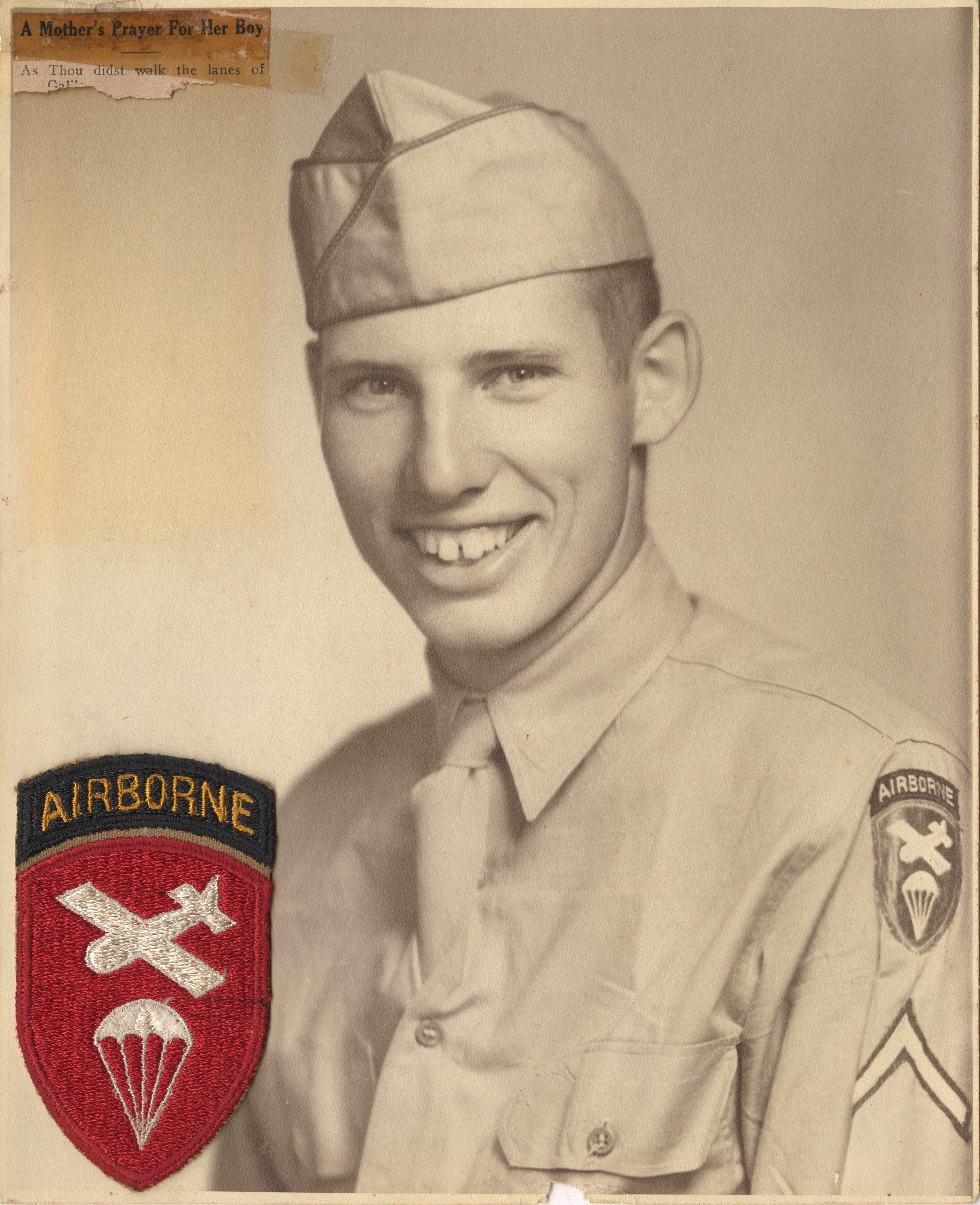
I want to tell you about Sergeant Julius James Wery.
His friends called him Jimmy.
Jimmy was my dad’s cousin — son of my Aunt Gert from Michigan.
And in the photograph my family has kept all these years, Jimmy is smiling. He is wearing the cocked side cap of a U.S. Army soldier. His shirt has a stripe and a half on the sleeve and an AIRBORNE patch on the shoulder — the 13th Airborne, 215th Glider Field Artillery Battalion.
He has all his teeth.
He has all his life ahead of him.
He is going to die in three years.
My Aunt Gert clipped a newspaper poem out and pasted it onto the matting of that photograph. The clipping is brittle now, the edges browned. It is titled “A Mother’s Prayer for Her Boy.” It begins —
“As Thou didst walk the lanes of Galilee…”
She did not know it yet when she pasted it on.
But that prayer would soon become the only thing she had left of him.
Unless you count the letters.
Seventy-five letters
My father — a retired Air Force Colonel, the family historian, the one who has spent the last decade carefully going through what our family kept — recently sat down to read Jimmy’s letters home to Aunt Gert.
There are seventy-five of them.
Seventy-five letters from a young soldier to his mother.
From Fort Bragg, from England, from France, from Belgium, from Germany.
The handwriting of a boy who would not live long enough to need reading glasses.
The handwriting of a man who was hoping, the whole time he was writing, that the war would be over soon and he could come home.
It almost was.
And here is what my father learned, reading those letters in his old age that he could not have learned any other way:
Jimmy was carrying things nobody at the front knew about.
His father — my Uncle Pete — had asked Aunt Gert for a divorce while Jimmy was overseas. Pete was barely writing his son. He was not answering Jimmy’s questions.
Jimmy was twenty-something, a Forward Artillery Observer in Europe, dodging German guns, and the letters from his dad had stopped coming.
I have done enough pastoral counseling in thirty years to know what that does to a young man.
But Jimmy also had something to live for. He had a wife. Her name was Rhea. They had married not long before the war pulled him in. And when he was in training at Fort Bragg, Rhea went and lived with him there. My dad reads that line in the letters and you can hear the gladness in his voice when he tells it. Thank God she got that time. Thank God they had those months.
Jimmy did not deploy until late 1944. He was almost going to miss the war. He almost made it.
He went through England, France, Belgium, Germany — the long, grinding final push of the Allies into the heart of the Nazi regime.
And in every letter, the same hope: Maybe this one ends soon. Maybe I get to come home.
A Forward Observer near Bastogne
Now I need to tell you about Jimmy’s job.
The Army assigned him as a Forward Artillery Observer.
I had to ask my dad to explain what that meant.
Here is the short version. In an artillery unit, somebody has to go ahead of the guns. Somebody has to crawl forward into the no-man’s-land between your side and the enemy’s side and find the German artillery positions. Find them. Spot them. Get close enough to call back coordinates so your guns can take theirs out before they take yours out.
Forward Observers were the eyes of the artillery.
They were also, statistically, the most likely men in the entire battalion to die.
You did not send the Forward Observer because he was unlucky. You sent him because he was good. You sent him because he could read the terrain and stay calm under fire and get the coordinates right. Jimmy was that man for the 215th.
His unit was near Bastogne — the town in Belgium that had been the center of the Battle of the Bulge that brutal winter. The Bulge officially ended in late January 1945. But the fighting in that area did not stop. It ground on through February. It ground on into March. Patrols still went out. Forward Observers still crawled forward. German guns were still out there.
On March 2, 1945 — sixty-seven days before Germany surrendered, while patrols continued in the long aftermath of the Bulge — Sergeant Julius James Wery was killed in action somewhere near Bastogne.
He was that close to coming home.
My father’s seventh birthday
My dad was seven years old on March 2, 1945.
He was a little boy in America. He had a birthday cake somewhere that day. He had no idea, when he blew out the candles, that his cousin Jimmy had just been killed in a Belgian field across the ocean.
He would find out soon enough.
And every March 2 for the rest of my father’s life — every birthday, every cake, every candle blown out by his children and his grandchildren and someday his great-grandchildren — has carried Jimmy’s date stitched into it.
Aunt Gert lost her son.
My dad — the same age as my grandson now — lost his birthday.
Some things never quite fix.
The letter from Lt. DeLeo
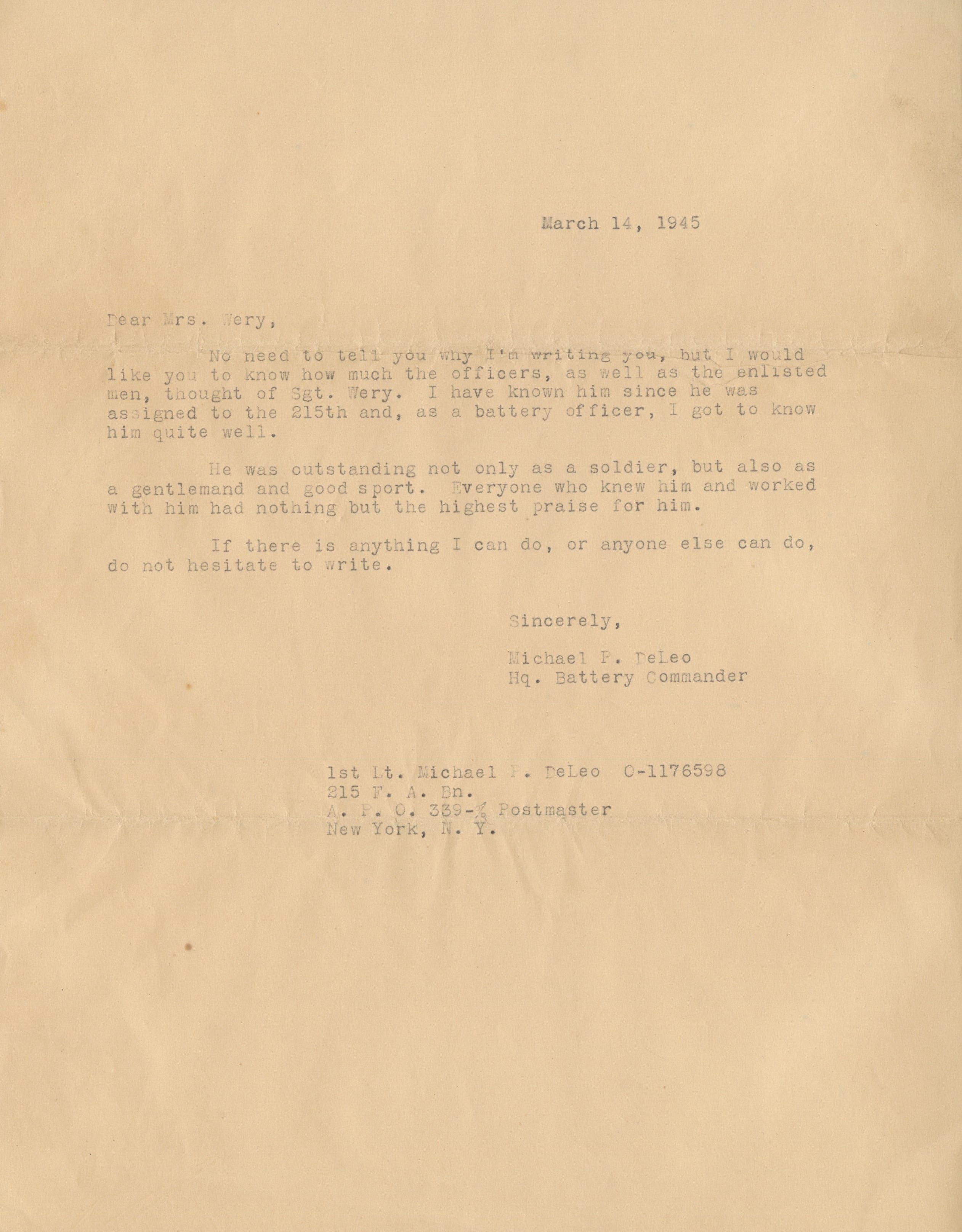
Twelve days after Jimmy died, his battery commander — a young 1st Lieutenant named Michael P. DeLeo — sat down at a typewriter somewhere in Europe and wrote a letter to Aunt Gert.
The letter is in my family’s possession. It is a single typed page, dated March 14, 1945. It reads, in part:
“Dear Mrs. Wery — No need to tell you why I’m writing you, but I would like you to know how much the officers, as well as the enlisted men, thought of Sgt. Wery. He was outstanding not only as a soldier, but also as a gentleman and good sport. Everyone who knew him and worked with him had nothing but the highest praise for him.”
That is the entire eulogy Jimmy ever received.
One typed page. From a young Lieutenant who had buried so many men he was running out of words.
Seventy-five letters home — and one letter back.
My father walked the rows
Decades later — decades after the war ended, decades after Aunt Gert was gone, decades after the world had moved on — my father and my mother flew to Belgium.
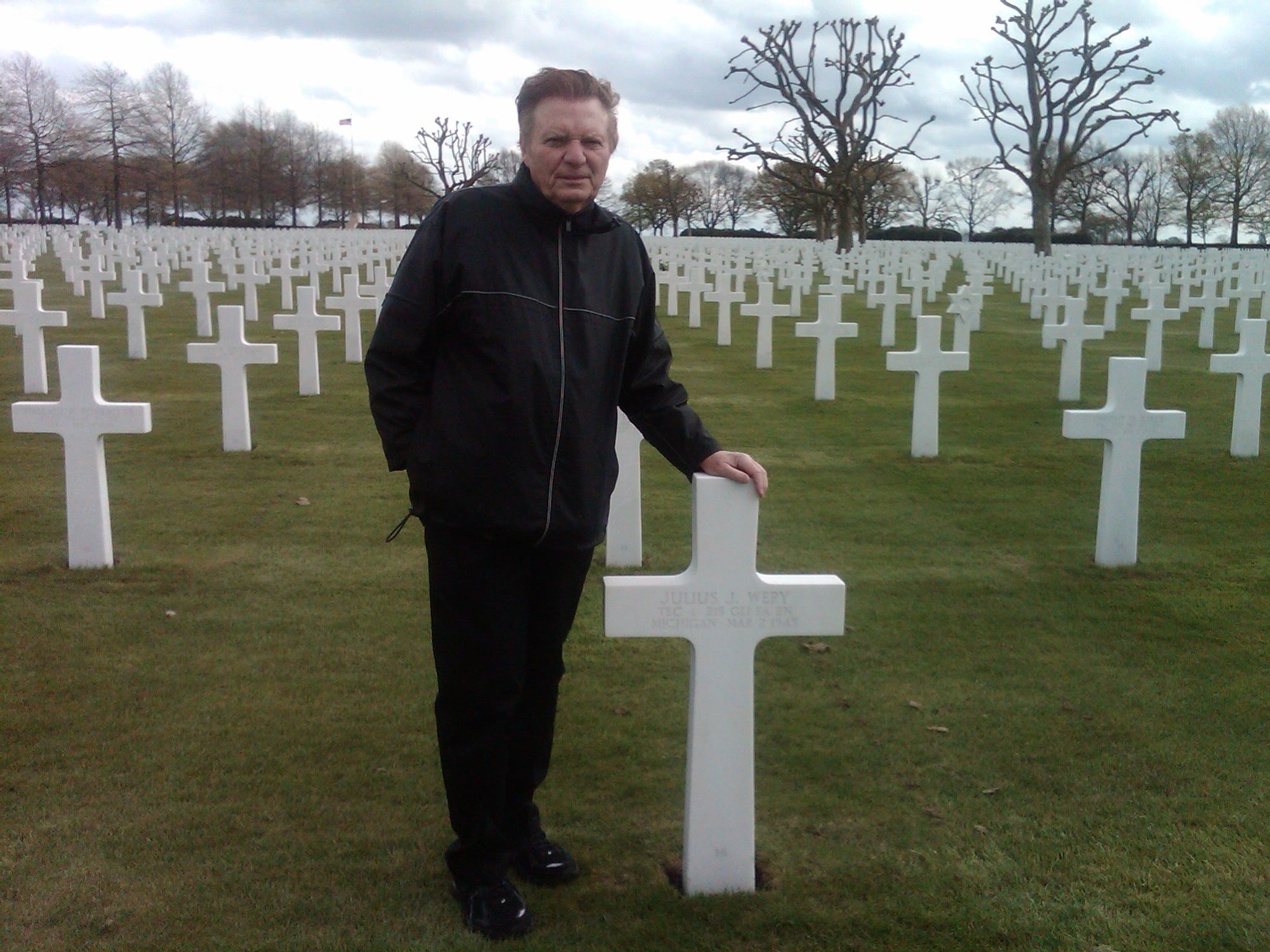
They took a taxi from Bastogne to the Netherlands American Cemetery at Margraten — about twenty minutes across the border. And they walked into a sea of white crosses, acre after acre, in rows that stretch farther than your eye can follow them. And they found Jimmy.
My mother — Jan, may she rest in peace, now buried herself at Fort Sam Houston — was the one who took the photograph.
In the picture, my dad is standing in a black jacket, in the wet European spring, one hand resting on the top of a single white cross. The cross says:
JULIUS J. WERY TEC 4 — 215 GLI FA BN MICHIGAN — MAR 2 1945
That photograph was taken in 2012.
My dad went and stood at his cousin’s grave. My mom went with him.
Because somebody had to. Because the stones do not work if nobody walks the rows.
Because what we remember on purpose, we keep alive on purpose.
There is almost no one alive today who knew Jimmy personally. Aunt Gert has been gone for years. Rhea is gone. Uncle Pete is gone. The men of the 215th are gone. The Lieutenant who wrote the letter is gone. The Dutch town that lays flowers at the graves every May does not know his story.
Only my family knows.
And when my family stops knowing — when my dad goes, and I go, and my boys forget — the pile of stones at Margraten will still be there. But the meaning of Jimmy’s stone will be gone. Just a white cross in a sea of white crosses, with nobody left to ask the question.
That is why I am writing this.
Meanwhile, in America
Meanwhile — back here in America — Memorial Day in 2026 is —
A mattress sale. A car sale. A 30%-off-everything-at-Kohl’s sale. A Memorial Day Hot Dog Eating Contest brought to you by Mattress Firm. A long weekend. A cooler. A boat trip. A lake house. The unofficial start of summer. And — for some Americans — a vague recollection that something serious is supposed to be happening today but they cannot quite put a finger on what.
I am not the snarky guy at the cookout. I will eat the hot dog. I am Texan. I am not above a good sale on patio furniture.
But friends — we have, as a country, completely lost the plot on this one.
Because somewhere between Jimmy under his white cross in Belgium and your patio at the lake house, something got dropped. And I think it is fair to ask, on a day like today — what was it?
Memorial Day is not for veterans
Let me say this carefully because it matters.
Memorial Day is not for veterans. That is Veterans Day. Veterans Day is in November. Veterans Day is for the men and women who served and came home.
Memorial Day is for the ones who did not come home.
That’s it. That is the whole point. The fold of the flag handed to the widow on the front porch. The empty chair at the table.
The boy with the AIRBORNE patch who never saw his mother again.
The wife at Fort Bragg who got the telegram.
That is what this day is about.
The people Memorial Day is for are not at the cookout. They are buried at Arlington. At Normandy. At the bottom of the Pacific. Under crosses in Belgium and the Netherlands — under one of those crosses, specifically, is Jimmy.
A pile of stones in the Jordan River
There is a moment in the Old Testament that has been on my mind this week.
In the book of Joshua, the Israelites cross the Jordan River into the Promised Land. God parts the water — same trick He pulled at the Red Sea, encore performance, God knows His audience. And after they get to the other side, God tells Joshua to do something that sounds odd at first.
Pick twelve men. One from each tribe. Have each of them reach down into the dry riverbed and pull up one stone. Carry those stones to the other side. And build them into a pile.
A pile of stones. That’s it.
And then God tells Joshua why.
“When your children ask in time to come, ‘What do these stones mean to you?’ — then you shall tell them.” — Joshua 4:6–7
That is what a memorial is.
A memorial is a pile of stones designed to make the next generation ask the question.
And when they ask, somebody who remembers gets to tell.
Memorial Day, properly understood, is the American pile of stones.
It is supposed to make our kids ask — what do these graves mean? Who were these people? — and then somebody who remembers is supposed to tell.
But the children have stopped asking.
And we have stopped telling.
And the stones have become a mattress sale.
So I am asking the question today. Out loud. To you.
What do these stones mean?
They mean Jimmy.
They mean a kid from Michigan whose dad had walked out on him while he was overseas.
They mean a young bride named Rhea who got her months at Fort Bragg and not the lifetime she signed up for.
They mean a mother in Michigan with a brittle newspaper clipping pasted to a photograph.
They mean seventy-five letters home and one letter back.
They mean a Forward Observer crawling forward to find the enemy’s guns so the rest of his unit could keep coming home.
They mean a seven-year-old boy in America who lost his birthday on March 2, 1945, and never got it back.
They mean Jimmy did not get to come home so the rest of us could.
He missed it by sixty-seven days.
The Christian connection
Here is why Memorial Day should hit harder for the Christian than for anybody else.
Because Christians, of all people, should know what to do with a day about people who died on behalf of others. Our entire faith is built on a Person who did exactly that.
Our God is not theoretical about sacrifice. Our God signed the document in blood a long time ago. Our God did not send a representative. Our God showed up — and stayed on the cross until it was finished.
So when American culture forgets how to honor the dead — we should not. Because we serve a Lord whose entire kingdom is built on the memory of His own death and resurrection.
Do this in remembrance of me, He said at the table. Until I come.
You eat the bread. You drink the cup. You remember.
You put the flag at half-mast.
You stand at the grave.
You remember.
Your assignment, today
I have given you my one name. Sergeant Julius James Wery. Jimmy. Michigan. March 2, 1945. Margraten. Aunt Gert’s son. Rhea’s husband. My dad’s cousin.
The Forward Observer who almost made it home.
Now you give me yours.
One — Find out the name of one person who died serving this country. Just one. Maybe it’s a family member. Maybe it’s a name on a wall in your hometown. Maybe it’s a name on the Vietnam Memorial you can pull up on your phone in thirty seconds.
Find one name.
Two — Say it out loud. Speak the name.
Three — Tell your kids who the name belonged to. Or your grandkids. Or your nephew. Or whoever is at the table. Make them ask the question. And then tell them.
That is the whole assignment.
You can still eat the hot dog. You can still go to the lake.
But somewhere between the lake and the mattress sale, put down a stone.
Speak a name.
Remember.
Because what we forgot on purpose, we became unworthy of on accident.
And what we remember on purpose — quietly, faithfully, generation after generation — keeps the price we paid from becoming the cost we forgot.
Rev. John
The Best Is Yet to Come / Your Hope Dealer / Pastor John (Rookie Roberts)
P.S. To my mom, Jan, who took the photograph in 2012 and rests now at Fort Sam — I love you. To my dad, whose plot waits beside hers and who is still, in his eighties, reading Jimmy’s letters and learning new things about a cousin who has been gone for eighty years — thank you for getting on the plane. Thank you for the taxi from Bastogne. Thank you for the seventy-five letters. To Aunt Gert — the Lord has heard your prayer these eighty years. To Rhea — wherever you are now, I hope you got to see him again. And to Sergeant Julius James Wery — Jimmy — Forward Observer, 215th Glider Field Artillery, killed in Belgium on my father’s seventh birthday, buried at Margraten under a white cross in a wet European field — we remember.
We are still here.
The stones are still here.
And so, in the only way that matters, are you.
Lovely! It makes me crazy when people blithely say Happy Memorial Day!
Thank you, John. This is a beautiful tribute to your family member. The person I always think of on Memorial day [other than saying a prayerful thank you and remembrance to all those who have died] is a friend from High School who died in Vietnam. King was the life of a party, but he was killed by a sniper during my sophomore year at A&I. It is important to keep those who sacrificed so much for us alive and honored in our memory!