
Ask the Bone Orchard

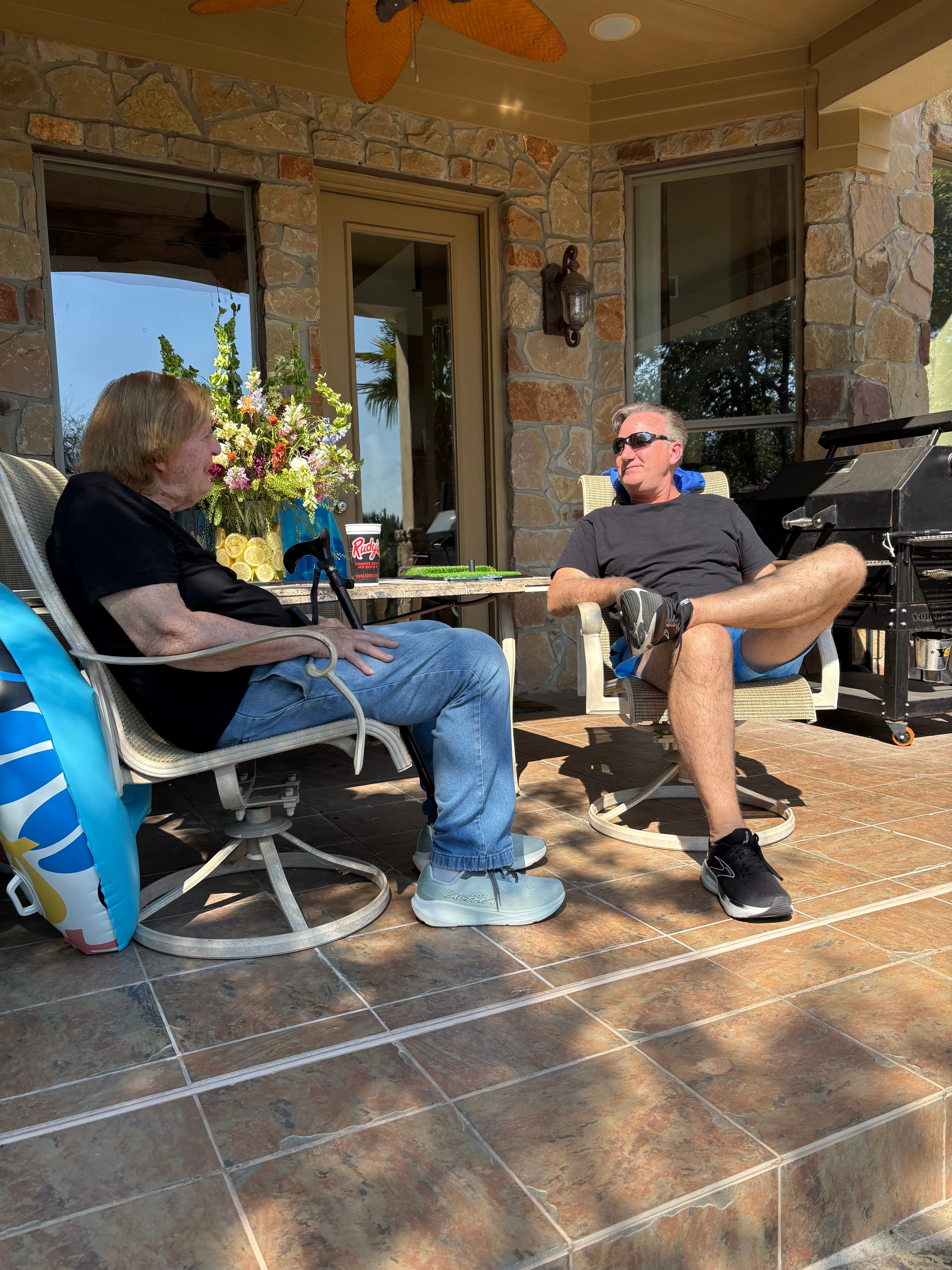
On Monday I spent some awesome time with family and with my dad.
He’s 88, and he did not want to talk about his health but a movie.
It was from ten years before I was born.
You ever seen the movie: The Fugitive Kind?
He wasn’t asking.
He was opening a door to see if I’d walk through it.
He ranks these things, my father — not his favorite movie, his second favorite, like a man reading a wine list who has real opinions about the whole vintage and not just the label everybody already knows.
The Fugitive Kind. 1960.
Brando in a snakeskin jacket, mumbling his way through the Deep South. And there was one scene, that’s all he wanted — a scene he has apparently been carrying around for sixty-some years, waiting for the right day to hand it to somebody.
The Scene He Was Actually Handing Me
Here it is, and I want you to see it the way he told it to me, because he tells things slow when they actually matter.
A woman named Carol Cutrere — played by Joanne Woodward — pulls her car over at a cemetery in the dark. The town calls it Wisteria Hills. She calls it, without blinking, the local bone orchard. And Carol is worth knowing a little about, because it is not an accident that this line comes out of her mouth and not somebody respectable’s. She used to be an activist — made stump speeches, wrote letters protesting the way her county treated its Black citizens, marched on foot for six miles before she was jeered off the road. Her family paid her to disappear rather than keep embarrassing them. So by the time we meet her, she has traded conviction for spectacle — reckless, drunk, chasing after being seen. In another scene she says it herself, almost as a confession: She wants people to know she’s alive. Noticed. Heard. Felt.
And this woman — the exile, the cautionary tale, the one the whole town has already filed under ruined — is the one who tells the drifter riding next to her that dead people don’t stay silent the way everybody assumes.
They talk.
They chatter out there like birds, she says.
But somewhere along the way, they only ever learned one word.
Live. Live. Live.
She says it about six more times, which is more repetition than most of you will tolerate from me on a Sunday.
That’s all the people in the graveyard say: Live, Live, Live…
And here’s the detail I didn’t catch until my father made me sit in it: earlier in that same movie, the drifter she’s talking to says something almost like her line, and means something almost opposite by it. I just want to live, he tells her. I don’t care whether they know I’m alive or not.
Carol wants to be seen alive. He just wants to actually be alive.
Same word, two completely different lives being described — and the whole scene at the cemetery is Carol, half-ruined and fully honest, finally landing on the version that’s true.
He Wasn’t Being Morbid. He Was Being Efficient.
I sat in the driveway a while afterward, about to drive home thinking about the conversation.
Understand what an 88-year-old man is doing when he picks a topic. He’s doing arithmetic. He knows the number of conversations left in the account is not large, and he just spent one of them on a cemetery scene from 1960.
Laura Carstensen at Stanford spent decades proving something that sounds obvious and isn’t: When people believe their time is unlimited, they collect. New contacts, new options, every door propped open for a someday that feels infinite.
When people know their time is short, they stop collecting and start editing.
So he isn’t losing his grip on the details.
He’s decided most of the details were never load-bearing.
Bronnie Ware sat with the dying for years and kept hearing the same regret at the top of the list. Not I wish I’d earned more.
I wish I’d had the courage to live my own life instead of the one everybody expected of me.
That sentence is a sermon.
Nobody gets to the last day wishing they’d been more careful.
Nobody. That’s not a survey. That’s a pattern.
So when the man who taught me to shine my shoes brings up a graveyard out of nowhere, he isn’t rambling and he isn’t afraid.
He’s been through the file, and this is what survived the cut.
He wasn’t quoting a movie at me. He was handing me the short list.
God Said It First
Let me put the collar back on, because Tennessee Williams didn’t invent this. He was late by about twenty-eight centuries.
Ezekiel 16. A newborn thrown out in a field, unwashed, unwanted, kicking in its own blood. Nobody’s coming. And God walks by and does not deliver a lecture. He says one word.
“Live.”
That’s the whole intervention.
One syllable spoken over something everybody else had already written off.
Moses does it at the end of Deuteronomy: life and death set out on the table like two chairs, and then the command.
Choose life. Not consider it.
Not pray about it for a season and form a subcommittee. Choose it.
And Jesus, who apparently never met a corpse He was willing to leave alone, keeps doing the entire thing in one word. To a twelve-year-old girl: get up. To a widow’s only boy on the way to his own funeral: arise. To a man four days in the tomb: come out.
Three funerals He attended. Three funerals He ruined.
The dead only know one word because God only ever needed one.
The One Graveyard Where the Message Changed
Williams named the play after Orpheus — the musician who walks down into the land of the dead to bring somebody back, looks over his shoulder, and loses her. The underworld keeps its inventory. That’s the play. That’s the movie. That’s a cemetery telling you to live and then keeping you anyway. Beautiful and hopeless, which is more or less the entire Tennessee Williams brand.
And notice, while we’re at it, who Williams hands the line to. Not the sheriff. Not the preacher. The disgraced woman the whole town has already buried socially, years before her body catches up. That is not an accident either, church — the truth about living almost always seems to come from the direction respectable people have stopped looking.
Then one Sunday morning outside Jerusalem, some women showed up at a tomb with spices and a plan for a dead body, and two men in shining clothes asked them the best question in the New Testament:
Why do you seek the living among the dead?
Catch the reversal. In every other graveyard on earth, the dead tell you to live. In that one, the living asked what everybody was doing hanging around the dead. Jesus didn’t come back from the underworld with a sad song about it. He came back with the keys and left the door propped open behind Him.
Which is why Luke can say God is not the God of the dead but of the living — because to Him, everybody is. Wisteria Hill isn’t a filing cabinet. It’s a waiting room.
You Can Be Breathing and Not Be Alive
Here’s the part that kept me in the driveway.
My father was not warning me about dying. He’s not particularly worried about that; he’s been to that briefing.
He was warning me about the other thing.
The thing where the heart keeps beating and the calendar keeps filling and the man himself quietly moves out sometime around year forty and forgets to tell anybody.
Scripture is blunt about this in a way we are not.
To the church at Sardis — respectable, well-attended, no scandals, probably an excellent building fund — Jesus says: you have a reputation of being alive, and you are dead. Not dying. Dead. Vitals fine, obituary already written.
He said it uglier to the religious professionals: whitewashed tombs. Beautiful on the outside. Bone orchard on the inside. You can pass every inspection anybody runs on you and still be a cemetery in a nice suit.
And when the prodigal comes stumbling up the road, the father doesn’t say my son was lost and now he’s found and leave it there. He says this my son was dead, and is alive again. That boy had a pulse the entire time. He ate. He slept. He made poor decisions in three time zones. Breathing the whole while, and his own father filed him under deceased.
A pulse is not a life. The coroner’s bar is very low. Don’t aim for it.
Paul says it flat out — we were dead in our trespasses, and God made us alive.
Alive is not the default setting.
Alive is something done to you and then something you keep choosing, most mornings, on purpose, usually before coffee.
You know the symptoms better than I do.
Waiting for the season to change.
Waiting for the kids to get older, the debt to clear, the boss to retire, the knee to settle, the right moment that has never once in human history announced itself.
Calling it prudence.
Calling it a season.
Calling it anything but what it is, which is a man idling in the driveway with the engine running and the tank draining.
The Stadium Is Not Yelling “Be Careful”
Hebrews says we’re surrounded by a great cloud of witnesses.
Whole stadium of them.
Every last one of them dead.
We picture them as polite.
Serene.
Sitting quietly in white robes, gently approving of our caution.
They are not sitting.
They are on their feet, and they are not saying what you think.
Not one of them is yelling pace yourself.
Nobody in that stadium is yelling there’s always tomorrow, because every single one of them ran out of tomorrows, and most of them ran out on an ordinary day they assumed was the middle of the story.
Nobody up there is yelling someday. Someday is the one commodity they no longer stock.
Nobody is yelling when the kids are older. Their kids are older. Their kids are up there with them.
Nobody is yelling wait till things settle down, because things never did, for any of them, not once in all of recorded history, and they know now that “settled” was never coming and was never the point.
Nobody is yelling play it safe, or don’t make a scene, or what will people think, or you’ve got time.
Look at who’s in the seats. Abraham, who left with no forwarding address. Moses, who picked the wrong side of the empire on purpose. Rahab, who bet her whole house on strangers. The ones Hebrews doesn’t even name — wandering in caves, sawn in two, destitute and afflicted — and the writer says of whom the world was not worthy. Those are your witnesses. Not one cautious man in the bunch. Nobody made that list by hedging.
They already know how the story ends. They have seen the scoreboard. And they have exactly one word, and they are screaming it down at you.
Five Minutes in a Chair
My father is not dead.
He’s very much alive, ranking movies and quoting Brando and outliving every expectation anybody ever set for him.
But he has moved close enough to the fence line to hear what they’re saying out there. And he came back and told me.
That’s what fathers do.
They leave something on the trail so the ones running behind them know which way to go.
And notice how it came. No fog machine, no French horns, no burning bush with proper signage — just an old man in a chair with five minutes and a movie that lost money in 1960. Jacob slept on a rock and woke up saying the most convicting sentence in Genesis: Surely the LORD was in this place, and I did not know it. God was already there. Jacob just wasn’t.
Holiness has appalling marketing. It shows up between the weather and the ballgame and never once identifies itself.
You’ve had a burning bush this month.
I’d bet the house on it.
Somebody said something to you in a checkout line or a hallway or a hospital room, and you filed it under small talk because it didn’t come with a soundtrack.
So Here’s Your Homework
Call the old person. Not text. Call. Better — drive.
And when they wander off into a movie from 1960 or a car they owned in 1974, do not do what I have done my whole life, which is wait politely for the story to be over so we can get back to the important business of discussing their medication. That is the important business. They’ve already done the editing. They’re handing you the short list.
Then go live — actually live, the Val Xavier kind, not the Carol Cutrere kind. Not the version that needs an audience to confirm it happened.
The version that would still be true in an empty room.
Make the appointment you’ve been circling for a year — the doctor, the counselor, the will you keep meaning to write.
Forgive the man, out loud, even if he never finds out, because you were never doing it for him.
Take the trip you’ve been saving for a someday that has never once shown up on an actual calendar.
Join the church — not attend it, join it, the kind of joining where somebody notices if you go missing.
Say the thing out loud while the person is still in the room to hear it: I’m proud of you. I forgive you. I was wrong. I love you and I don’t say it enough.
Sell the house that’s too big for the life you’re actually living.
Leave the job that’s been quietly hollowing you out for a paycheck that was never worth what it cost.
Have the harder conversation.
Stop rehearsing the speech and give it.
None of that is reckless, church.
Reckless is noise with a shorter runway.
This is just obedience with a deadline you finally admitted you have.
Jesus said He came so you’d have life and have it to the full.
If you’re spending yours on the sidelines out of an abundance of caution, that isn’t humility. That’s being wasteful with a gift somebody died to hand you.
The dead get one word. You still get all of them.
Use a few.
Let’s pray.
Lord, We have gotten very good at careful and very bad at alive. Thank You for fathers who preach without announcing it, and for five ordinary minutes that turn out to be holy ground. Teach us to number our days, and give us the nerve to spend one.
In the name of the One who walked out of the graveyard alive, Amen.
Your Hope Dealer
Rev. John Roberts
What a wonderful message for us all. I am going to try and find that movie and watch it. But more than that--I am going to focus on actually living for the remainder of my time on earth!