
Good Vibes Only

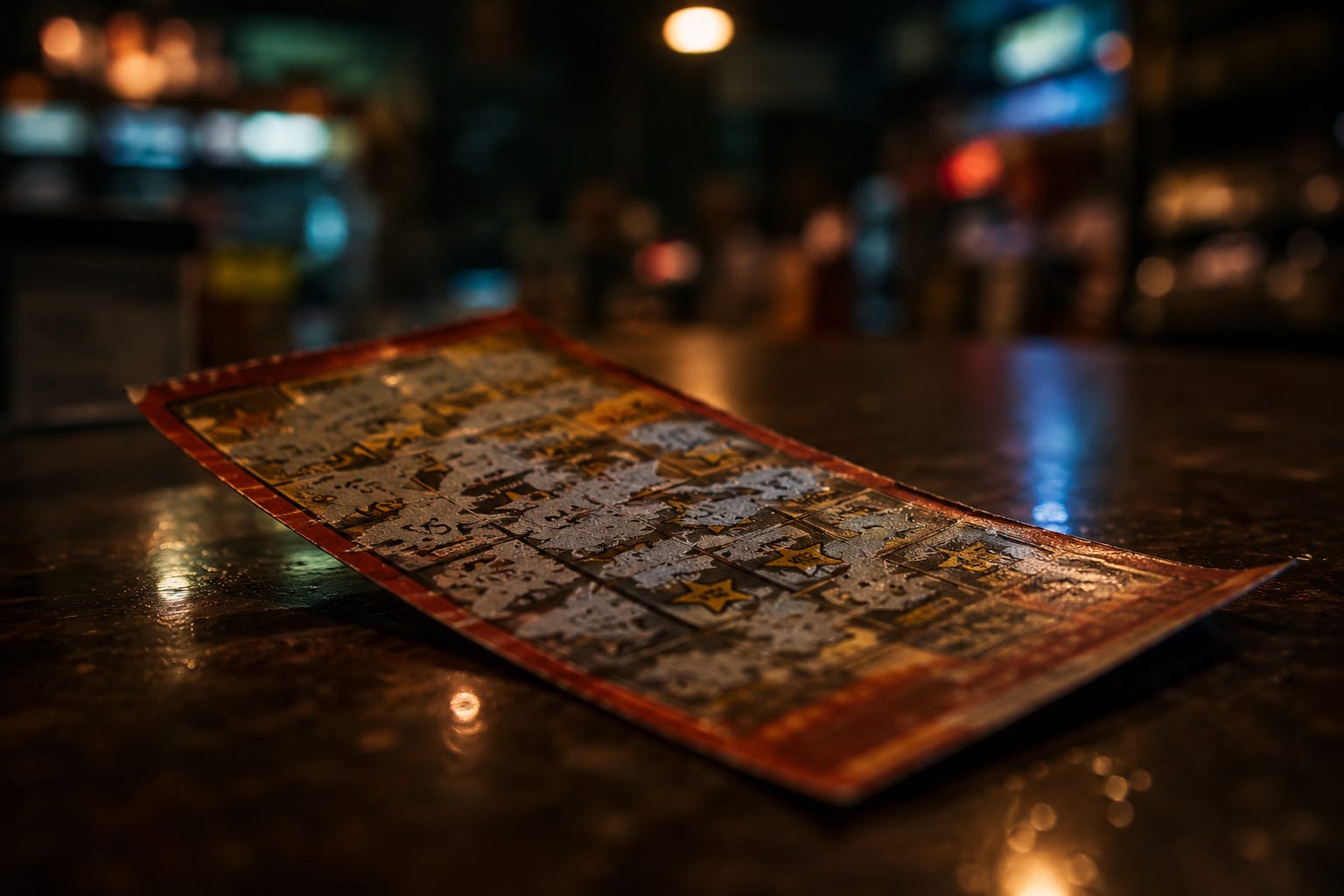
Americans spend well over a hundred billion dollars a year on lottery tickets.
Let that number sit there a second.
That is more than we spend on movies, video games, music, and sporting events put together.
Combined.
Every year.
That is not entertainment spending, church.
That is the national hope budget, and you can pick it up at Stripes or Buc-E’s somewhere between the beef jerky and the energy drinks.
Two dollars, a scratch-off surface, and about eleven seconds of believing your life is going to be different by Thursday.
It is the purest product ever invented, when you think about it.
It asks absolutely nothing of you.
No skill, no plan, no effort, no follow-through, no risk beyond the two dollars.
You are not required to change one single thing about your life. You just have to want it and wait.
We have built a hundred-billion-dollar industry around the one version of hope that requires nothing from the person hoping. And then we wonder why hope feels so flimsy.
Or, If You Prefer, the Vision Board
And if the lottery is a little too blue-collar for your taste, we have upscale versions.
We have vision boards, which is a collage. We took a third-grade art project, hung it in a walk-in closet, added a candle, and called it a financial strategy.
We have manifesting, where you simply announce a thing to the universe with sufficient confidence and the universe, which has no ears, no money, and no opinions about you personally, is expected to deliver.
Manifesting is prayer to a god who cannot hear you and could not help you if He did.
We have good vibes only, which is a sign people hang in kitchens where somebody is quietly falling apart.
And we have the whole inspirational-quote economy, where a photograph of a mountain with cursive letters over it counts as a plan.
I have watched people share those for years and never once take a step in the direction of the mountain.
Every one of those is hope with the working parts removed.
It is a wish wearing hope’s jacket.
What Hope Actually Is
Now here is what interests me, and it is the reason I am writing this.
For decades, a psychologist named C. R. Snyder spent his career studying hope — actually measuring it, in thousands of people, trying to figure out what it is and what it does. And his conclusion is not what most people in a pew would guess.
Hope, in the research, is not a feeling. It is not optimism. It is not a sunny disposition.
Snyder found that hope has three working parts.
You have a goal — something specific you are actually after.
You have pathways — routes you can see to get there, and usually more than one, because the first road always washes out.
And you have agency — the belief that you can walk them, and then, critically, the walking.
Which means the difference between a hopeful person and an optimistic person is not their mood.
It is that when the first road closes, the hopeful person starts looking for the second road, and the optimist keeps waiting on the first one to reopen.
Optimism says it is going to work out. Hope says here is how, and I am leaving Tuesday.
The Optimists Died First
And if that sounds like a distinction without a difference, let me tell you about Admiral James Stockdale.
Stockdale was the highest-ranking naval officer held at the Hanoi Hilton during Vietnam. Seven and a half years as a prisoner of war. Tortured more than twenty times. No release date, no rights, no idea if he would ever go home.
Years later, the writer Jim Collins asked him who did not make it out of there. And Stockdale’s answer has stuck with everybody who has ever heard it.
He said: the optimists.
They were the ones who said we will be out by Christmas. And Christmas would come and Christmas would go. Then they would say Easter. And Easter would come and go. Then Thanksgiving, then Christmas again. And Stockdale said they died of a broken heart.
Then he gave the line that ought to be on a plaque in every church in America: you must never confuse faith that you will prevail in the end — which you can never afford to lose — with the discipline to confront the most brutal facts of your current reality, whatever they might be.
And notice what Stockdale himself actually did in that prison, because this is the part people skip. He did not sit in a cell being spiritually positive. He built a tap code so the prisoners could communicate through walls. He organized rules of resistance. When they wanted to parade him for propaganda film, he deliberately disfigured his own face so they could not use him. That man’s hope had a work schedule.
Stockdale did not survive because he felt hopeful. He survived because his hope had chores.
Which One Comes First
Now here is the part that turns this whole thing around, and it is worth knowing whether you ever open a Bible or not.
One of the most effective treatments in existence for depression is a thing called behavioral activation. And the premise of it is almost offensively simple:
You do not wait until you feel like doing things. You do the things, on a schedule, whether you feel like it or not, and the feelings come along behind.
That is not motivational-poster talk.
It has been tested in serious clinical trials against medication and against cognitive therapy, and it holds its own.
Get out of bed.
Go for the walk.
Call the person.
Do the small thing you have no desire to do.
And measurably, reliably, the mood follows the movement.
We have it backwards, church, and we have had it backwards our whole lives.
We are all sitting around waiting to feel like it, and feeling like it is not the engine.
Feeling like it is the exhaust.
Action does not wait on the feeling.
Action goes and gets the feeling and brings it back.
Seventeen Shekels
Which brings me to my favorite real estate transaction in the Bible, and almost nobody preaches it.
Jeremiah, chapter thirty-two. Set the scene, because the scene is everything.
The Babylonian army is camped outside Jerusalem. The siege is underway. The city is going to fall — Jeremiah himself has been saying so for years, which is precisely why he is not out among the people at this moment. He is locked in the courtyard of the guard, in custody, by order of his own king, for telling the truth about what is coming.
So: prison. Enemy army at the wall. National collapse on the calendar. And God tells Jeremiah his cousin Hanamel is going to show up and offer to sell him a field in Anathoth.
Real estate, church. In a country about to be conquered. Sold by a relative, which is its own red flag.
And Jeremiah buys it.
Seventeen shekels of silver.
He weighs out the money in front of witnesses. He signs the deed. He has it sealed, and he has an unsealed copy made, and he hands both to his assistant Baruch with instructions to put them in a clay jar so the documents will survive a long time.
Read that last part again. He did not just buy the field. He went to the trouble of archiving the paperwork so it would outlast the war.
And God tells him why:
Houses and fields and vineyards shall again be bought in this land.
Jeremiah did not write a poem about the future.
He bought a piece of it, at market rate, and filed the receipt.
That is hope, church.
Not a mood.
A deed, a witness list, seventeen shekels of actual money, and a clay jar.
The Whole Book Is Verbs
And once you see it there you cannot stop seeing it.
Noah did not hope it would not rain. He built a boat, for years, in a climate that gave him no evidence, in front of neighbors who had opinions.
The widow in Second Kings with one jar of oil and a creditor coming for her sons — the prophet does not tell her to have faith. He tells her to go borrow empty vessels from everybody she knows, and not a few. And the oil kept flowing until she ran out of containers. Her miracle was measured, exactly, by how many jars she had gone and gotten.
Four lepers sitting outside a starving city said why are we sitting here until we die — and got up.
And go read Hebrews eleven sometime, the great roll call of faith, and notice something about how it is written. By faith Noah built. By faith Abraham went out. By faith Moses left. By faith they passed through, they conquered, they shut the mouths of lions.
There is not one adjective in that entire chapter, church. It is verbs from top to bottom. God did not put anybody in the hall of fame for how they felt about it.
Why Ours Is Not Wishful
And let me tell you the difference between all of this and simply cheering yourself up.
The word the New Testament uses for hope does not mean what our English word has come to mean.
When we say I hope so, we mean I have no idea and I would prefer a good outcome. That is not what the Bible means.
Biblical hope is confident expectation — anticipating something you have solid reason to believe is coming.
And here is the reason.
Christian hope is not built on a feeling about the future. It is built on an event in the past. A tomb that was full on Friday was empty on Sunday, in a specific city, on a specific morning, in front of specific people who then spent the rest of their lives getting killed rather than take it back.
Which means our hope looks backward before it looks forward. It is a memory pointed at tomorrow.
And notice, God did not sit in heaven hoping about us. He did not manifest. He did not put it out into the universe. He got up and came down here and did something about it, at enormous cost, with His hands.
God has never once in all of Scripture hoped at somebody from a distance.
Every promise He ever made, He got up and went and did.
WHAT TO DO:
Name the thing you have been hoping about.
The actual thing. The marriage, the job, the kid, the health, the calling, the debt, the reconciliation.
Now go buy your field.
Whatever the smallest real, physical, dated version of that hope is — go do that one. Make the appointment. Send the email. Open the account and put twenty dollars in it. Get the number and call it. Sign up for the class. Ask for the meeting. Buy the seventeen-shekel version of the thing you have been asking God about, and do it before Friday.
You are not doing it because the action makes God move. He is not for sale, and He is not slow. You are doing it because that is what hope has looked like every single time it has appeared in Scripture, in research, or in a prison camp in Hanoi.
Hope is not the feeling that it will work out, church.
Hope is what you do on Tuesday because you believe it will.
Go buy the field.
Your Hope Dealer,
Pastor John (Rookie Roberts)
Jeremiah 32:6–15 · 2 Kings 4:1–7 · Hebrews 11 · Romans 5:1–5 · 1 Peter 1:3
Thank you, John for this great devotional! We all need hope in our lives! I will take your words to heart and do those things I need to do, not put them off. I will focus on how to keep my hope alive!