
He Had Seen Some Things
The people who help you are never the ones who were never hurt.

“Pastor, you don’t understand my life.”
Six words.
I have heard them more than any other sentence in thirty years of doing this.
And the man who said them across the desk from me that afternoon didn’t say them to be cruel.
He said them the way a drowning man grabs a fistful of your collar.
He wasn’t insulting me.
He was checking.
He needed to know whether the guy in the clergy collar had ever actually been in the water — or whether I’d only read about drowning in a book, from a deck chair, with a whistle around my neck and my feet dry.
And here’s the strange thing.
In that moment I did not reach for my seminary degree.
I did not reach for a commentary.
I reached for my limp, my scar.
I told him a little — not all of it, just enough — about a season of my own where the floor gave out.
Where I wasn’t sure I’d ever stand in a pulpit again.
Where I found out exactly how far down a person can go and still come up with God’s fingerprints on him.
I didn’t hand him a lecture.
I showed him a wound.
And I watched his shoulders come down about two inches.
He exhaled.
And he started to talk.
He didn’t trust my diploma. He trusted my limp.
I used to believe my wounds disqualified me.
I really did.
I thought the whole point of the Christian life was to arrive at the front of the church polished, buffed, shrink-wrapped, and scar-free — a man in showroom condition with no history, only credentials.
And then I lived a little.
Got some seasoning on me.
Went through a wilderness or two, came back as John 2.0 — and learned the one thing nobody prints on the diploma:
Every pastor worth anything is a wounded healer.
Every single one.
The people who actually help you are never the ones who were never hurt.
They’re the ones who got hurt, took it to God, and came back with a map.
If your shepherd has never bled, be careful.
He’ll hand you theology all day long — he just can’t hand you a hand up out of the pit, because he has never once been down there.
He’s giving you directions to a country he’s only seen on a postcard.
Now hear me, because this is the hinge of the whole thing.
There is a difference between a wound you have walked through with God and a wound you have buried alive.
And that difference is everything.
Because here is what I have learned about a buried wound:
A wound left alone does not become a memory. It becomes a manager. And it manages you.
You think that old thing died years ago.
It didn’t die.
It got promoted.
It’s sitting in the corner office of your soul right now with its name on the door, running meetings you don’t even know are on the calendar.
Why do you come unglued at that one particular tone of voice?
The manager scheduled that.
Why do you blow the thing up right before it goes well?
The manager signed off on it.
Why can’t you take a compliment without flinching like somebody raised a hand?
The manager doesn’t allow that on the premises.
You think you’re free.
You’re just being run by a middle manager you never hired and have somehow never fired.
You gave it equity.
There was a doctor named Vincent Felitti who ran the Department of Preventive Medicine at Kaiser Permanente in San Diego.
And back in the 1990s, working with Dr. Robert Anda at the CDC, he did something almost nobody bothers to do.
He looked at more than seventeen thousand ordinary, middle-class, mostly college-educated adults and asked a question medicine mostly skips:
What happened to you as a child?
What he found rearranged the furniture of modern medicine.
He found that hidden childhood wounds do not politely dissolve with the passing of time.
Time does not heal all wounds.
Time does not heal what you refuse to face.
Time just gives it seniority.
In other words — and here’s what I find as a pastor —
We keep treating the smoke and we never touch the fire.
The smoke is what everybody can see.
The smoke is the depression.
The addiction.
The rage that arrives three sizes too big for the moment.
The anxiety that will not sit down.
And we will do anything about the smoke — medicate it, manage it, buy products for it, feel ashamed of it, build a whole personality around waving it out of our eyes — anything except walk into the other room and ask where it’s coming from.
This is why Jesus never concentrated on the sins of the flesh — the smoke — but rather the sins of the heart — the fire!
The fire is the wound nobody ever addressed.
Researchers found that one in six of those perfectly ordinary people were carrying four or more of those buried wounds, and the more they carried, the higher their risk of nearly everything that eventually walks into a doctor’s office thirty years later.
The body keeps the receipt.
And church — we do the exact same thing with sin and struggle.
We rebuke the smoke.
We’ve got whole ministries dedicated to fanning the smoke out of the sanctuary.
And we have never once knelt down at the fire.
God is not impressed by your smoke management.
He’s after the fire.
Which brings me to a question I don’t think we ask nearly enough.
Why did Jesus wait until He was thirty?
Thirty years.
God, in the flesh, walking around Nazareth — and He waits three decades before He preaches a single sermon.
Part of it is the law; The Levites didn’t enter their full priestly service until thirty.
There’s an order to these things, sounds Presbyterian if you ask me! Ha!
But I wonder if there’s something else underneath the order.
I wonder if part of the answer is simply this: By thirty, He had seen some things.
Look at the life He’d actually lived.
He entered the world as a refugee — His family running for the border in the dark because a paranoid king was murdering baby boys to protect his own throne.
He grew up poor in a town with a bad reputation — can anything good come out of Nazareth?
And somewhere in those silent years, Joseph quietly disappears from the record.
After the temple, when Jesus is twelve, we never hear Joseph’s voice again — not at a wedding, not at a cross.
Most scholars think the earthly father Jesus loved died sometime in those hidden years.
Which means before Jesus ever raised a single dead man, He had very likely already stood at a graveside of His own.
He had seen some things.
He had grief on Him.
He had dust on Him.
By the time He stood up to speak in public, He was not a theory about suffering. He was a man who had tasted it.
And I want you to notice who He went to war for. Because I don’t think it’s an accident.
Watch the way Jesus treats women.
In a world that filed them under property, He stops for the woman at the well — five failed marriages behind her, drawing water alone at noon to dodge the whispers — and makes her the first evangelist in her entire town.
He steps His own body between a woman caught in adultery and a circle of respectable men already weighing rocks in their hands.
He lets a bleeding, ceremonially “unclean” woman grab His clothes in a crowd and, instead of recoiling, calls her daughter.
And when He walks out of the grave — the single greatest moment in the history of the universe — He hands the first announcement not to an emperor, not to a general, not even to the twelve, but to Mary Magdalene.
He made a woman the first preacher of the resurrection.
Why would He be like that?
Well. I wonder.
Because I think He grew up watching a woman get whispered about.
Do the arithmetic the way that village did.
His mother turns up pregnant before the wedding, and small towns count on their fingers — and they never, ever stop counting.
Look at how it followed Him.
When He goes home to preach, the hometown crowd tries to cut Him down to size with it: “Isn’t this the carpenter, the son of Mary?” (Mark 6:3).
Read that again.
In that culture you were named for your father — Simon bar-Jonah, James son of Zebedee.
Nobody was called “son of Mary” while a father’s name was available.
To say it to a grown man’s face, in front of the synagogue, was a polished little dagger — we all remember there was a question about you. Matthew, writing it down years later, can’t quite stomach it and softens it back to “the carpenter’s son” (Matthew 13:55).
But Mark leaves the knife in.
And it gets uglier.
In the middle of a hostile argument in John 8, His critics reach for the oldest rumor in Nazareth and throw it: “We are not illegitimate children,” they sneer — the older translations put it bluntly, “We be not born of fornication” (John 8:41).
Hear the emphasis. We aren’t. Meaning: not like you.
Thirty years into His life and grown men are still using His mother’s timeline as a weapon.
Jesus grew up as the boy people whispered about.
Mary raised her son under a cloud of gossip that never fully lifted, and I believe He watched her absorb it — quietly, with her chin up — for thirty years.
So when He finally met a woman the world had labeled and shamed and thrown down in the dirt, He did not see a category.
He saw His mama.
And He had exactly zero tolerance for the men holding rocks.
His wound didn’t make Him bitter toward the broken.
It made Him a champion for them.
That is what a healed wound does.
It does not harden you against the hurting. It makes you fluent in them.
There’s a phrase Henri Nouwen gave the church that I’ve never been able to improve on: The wounded healer.
But Nouwen didn’t invent it.
He borrowed it from the only Healer whose wounds are eternal.
Because here is the gospel, and it will preach at your funeral and it will preach at mine.
When Jesus rose from that grave, He came back glorified. New. Deathless. He could have come back airbrushed — every mark of Rome erased, every trace of the nails buffed smooth. Flawless. That is precisely the version we would have designed for Him. A risen Lord with no receipts.
He didn’t do it. He kept the scars.
He walked through a locked door, found Thomas — poor doubting Thomas, the one who flatly refused to believe — and He didn’t scold him. He said, put your finger here. Touch the holes. Reach your hand into My side. The risen, reigning, glorified Lord of the cosmos deliberately carried His wounds into eternity — and then used them as the credential, the proof, the way home for the one man in the room who couldn’t otherwise find it.
There are scars in heaven, friend.
On purpose.
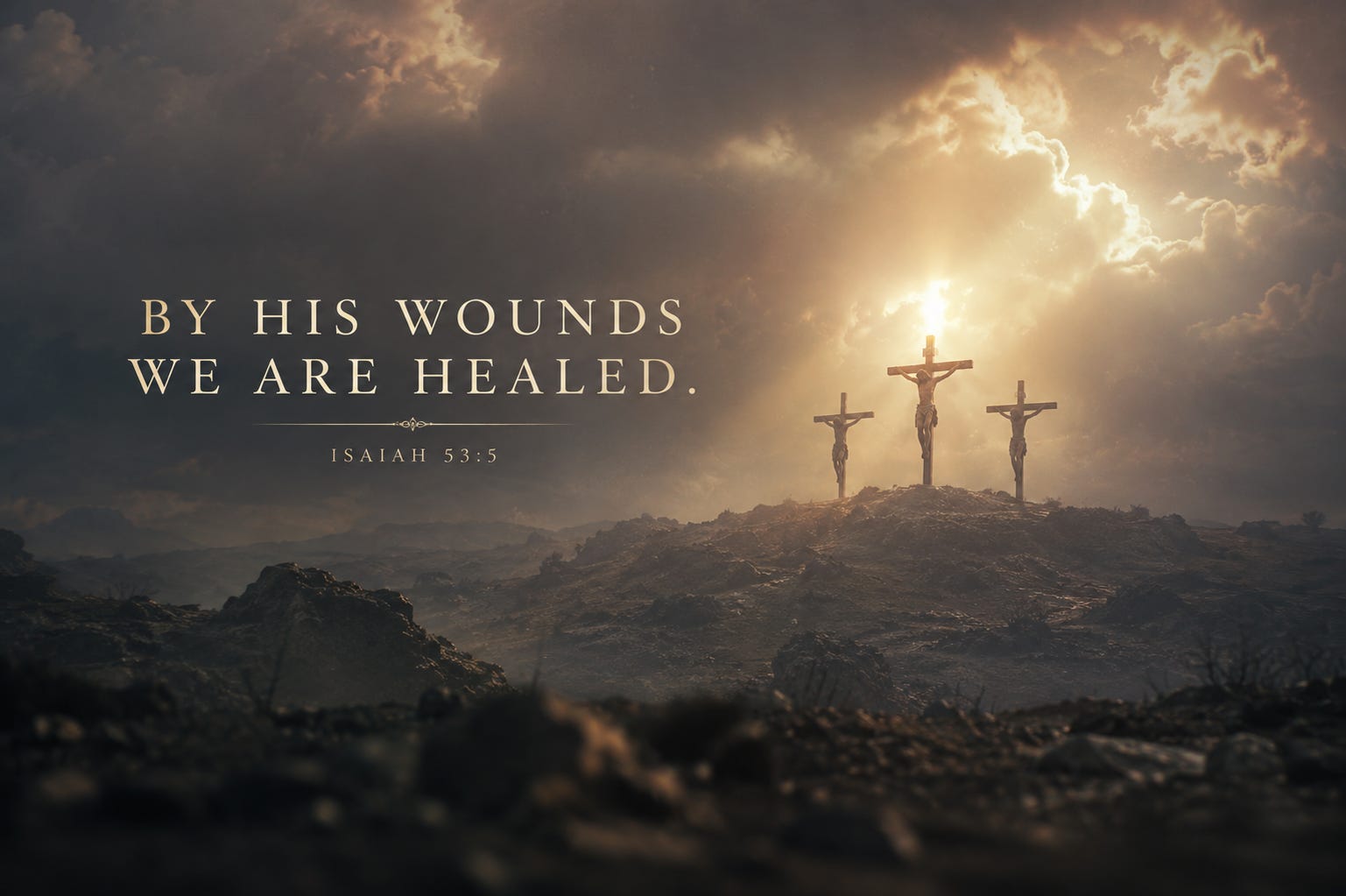
Isaiah saw it coming seven hundred years out: by His wounds we are healed. Not in spite of them. By them.
The very thing that was done to Him became the very thing that saves you.
By His wounds you are healed.
So let me say it as plainly as I know how, to every wounded person reading this — which is all of you, whether you’ll cop to it or not.
Your scars are not your disqualification.
Handed to Jesus, they become your assignment.
That thing you are most ashamed of — the fire underneath all your smoke, the wound you have been quietly paying to manage for years — it does not have to keep running your life from the corner office.
You are allowed to walk in there and hand Him the keys.
Because a wound left alone becomes a manager, and it manages you.
But a wound surrendered to the Wounded Healer becomes a minister — and it clocks in for somebody else.
Don’t waste your scars.
Somebody down in the pit you already climbed out of is looking up right now, and they are not going to trust your diploma.
They’ll trust your limp.
Show them the scar. Point them home.
Your Hope Dealer, Pastor John (Rookie Roberts)
The Best Is Yet to Come.
❤️❤️❤️
I love this! I have scars from the past that relate to wounds and pain that have troubled me for so many years. I love the way you bring a very real example from Jesus' life to speak to such old wounds, and what happens when they are turned over to God. He helps and he heals. Scars may remain, but they are the way we keep learning! Thank you, John!