
John 2.0
A letter from your returning pastor. (Some assembly still required.)
Dear Grace Church,
It is good to be home.
And before I say one theological word — because that is, traditionally, what you pay me for — I want to acknowledge a few things.
I served this church for twelve years before I left.
In those twelve years, I made some mistakes.
Some of them were glaring. The kind that come up at congregational meetings and have their own subcommittee. The kind that some of you have, lovingly and with great Christian patience, brought up to me three or four times in case I had forgotten.
I had not forgotten.
Some of them were quieter. The kind I am still discovering on my own, sometimes at three in the morning, when the ceiling fan in the suite I am still living in is doing its impression of the Holy Spirit’s conviction.
And then there were the sermons.
The sermons, beloved, ran a touch long.
“A touch.”
Like the Atlantic Ocean is a touch wet.
Like Texas in August is a touch warm.
Yes. The sermons ran long. I have heard you. I have read the comment cards. I have noticed the gentleman in the back row whose watch beeps at the forty-five-minute mark.
I see you, sir. I am working on it.
But I want to tell you what I have been telling Baby Doll for a few months now, and what I think is the most important thing I have learned in nine months away from this pulpit.
I came back different. And I want you to know what that means.
I Am Calling This Era John 2.0.
Same model. Same chassis. A few new dents.
Slightly improved firmware.
I have been joking with my wife about it. I walk into the kitchen and announce, “John 2.0, reporting for breakfast,” and she looks up from her coffee with the expression of a woman who has heard a lot of announcements over thirty-two years of marriage and is reserving the right to verify the update.
Which is fair.
Because the version-numbering trick only works if the new version actually does new things.
But here is what I have come to understand, and what I want to put in front of you this morning as the major teaching of this letter:
It is shockingly easy to give yourself permission to change — and shockingly hard to forgive yourself for not having done it sooner.
Psychologists have a name for what I am describing.
They call it self-concept revision.
It is the documented finding that people change far more easily when they explicitly name a new identity — I am the kind of person who does this now — than when they fight against the old one.
Think about it.
“Trying not to lose my temper” keeps the temper at the center of your imagination. “Becoming the kind of man who is patient” moves the temper to the periphery and puts something new where it used to be.
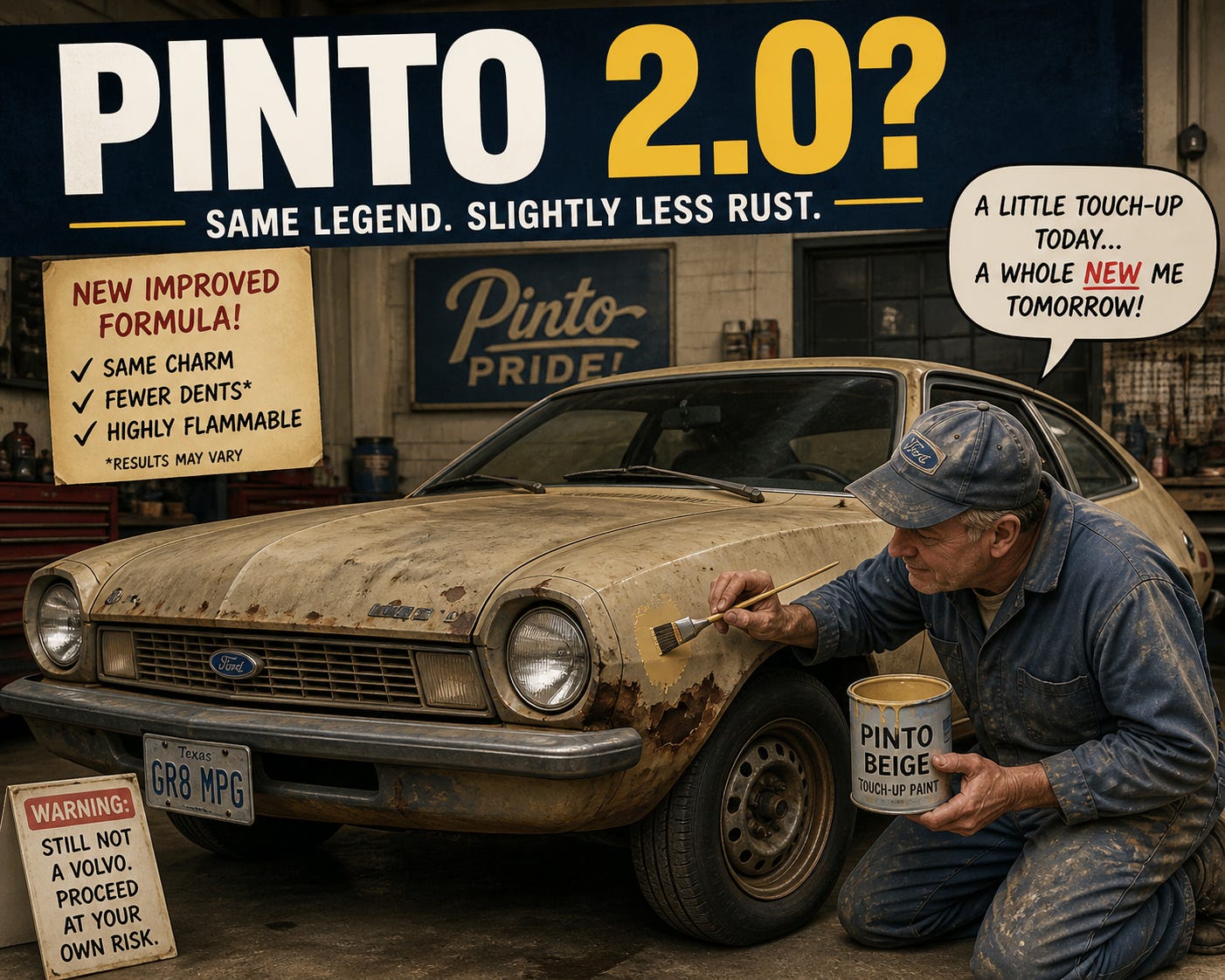
No one Preaches Like A Ford Pinto…
The Ford Pinto was an econobox. Made in the seventies. Cheap. Got decent gas mileage. Fit in tight spaces.
And it was famous for one thing.
The fuel tank was located behind the rear axle. Any hard impact from behind — a fender bender, a parking-lot tap, the wrong kind of Tuesday — and the gas tank would rupture.
And the car would explode.
Ford knew. The engineers had filed reports. The company shipped it anyway because the math said it was cheaper to settle the lawsuits than to redesign the gas tank.
Lord, have mercy on Detroit. And on the rest of us.
The young pastor who started ministry thirty years ago had a Pinto’s gas tank.
Nice paint. Got me places. Real charm in the right light. But under any kind of impact — the wrong meeting, the wrong criticism, the wrong week —
the gas tank did what gas tanks do.
And the people closest to me had to stand back from the heat.
And here is the thing I want you to hear about that season, because the whole rest of this letter depends on it.
God did not sell me touch-up paint.
God built me a different car.
He pulled me off the road, took the Pinto off the lot, and gave me a vehicle that was not built to ignite under pressure.
That happened sometime around the end of my first decade in ministry. I will not pretend I can name the day. It was not a single moment. It was a long, slow, patient act of God installing a different chassis underneath me.
The 2.0 move is not white-knuckling the old version into compliance.
It is naming a new version and walking out the door wearing it.
And the wild part is — you are allowed to do that.
There is no committee that has to approve.
There is no certificate you have to mail in.
The Holy Spirit signed off on the update at Pentecost in the form of a Person, not a permission slip.
“Therefore, if anyone is in Christ, the new creation has come: The old has gone, the new is here!” — 2 Corinthians 5:17
Paul did not say “the old is gradually being phased out via a six-step program with continuing education credits.”
Paul said “the new is here.” Present tense. Already. Now.
Tell People.
Here is the part I am most excited to tell you about, because this is the part I had not understood until this season.
It is not enough to update the software in private.
You have to announce the version number out loud.
Because here is the truth about the people who know you well — your spouse, your kids, your coworkers, your congregation:
They have a file on you.
It is a thick file. It has been growing for years. It contains every promise you didn’t keep, every fight you started, every meeting you ran twenty minutes long, every Christmas you were emotionally absent for, every sermon that ran past twelve-fifteen and made them late for the buffet line at El Catrin.
You know the file.
And until you tell them otherwise, the file is the version of you they keep referencing.
Psychologists call this the fundamental attribution error.
It is the documented human tendency to assume that people are the way they have been.
If you yelled in 2007, you are a yeller.
If you forgot the anniversary in 2014, you are forgetful.
If you ran the sermon long in March, you will run the sermon long in October —
— and yes, sir, your watch will beep again.
Until somebody breaks the spell by saying out loud, I am not that version of me anymore.
When you announce the update, you are not just changing yourself.
You are inviting the people around you to stop reading the old file.
So here is what I am announcing, today, in writing, to this congregation:
I am John 2.0.
Judge me by my new mistakes.
Not my old ones.
I will make new mistakes. I am not a saint. I am a fifty-five-year-old preacher with knees that make sounds when I climb the platform and a tendency to think I am funnier than I actually am.
But I am asking you, the people I love and who have loved me back for twelve years and counting, to please stop running my old version through the simulator.
There is a new build. It deserves its own bug report.
And Here Is What I Am a Little Ashamed Of.
I am going to be honest with you, because that is what 2.0 is for.
I am a little ashamed it took me thirty years of ministry to figure this out.
Because the move I am describing is not theologically advanced.
It is not seminary-level.
It is not the kind of thing you have to read three Puritan sermons to discover.
It is roughly the third grade of the Christian life.
Repent. Renew. Walk in the new direction. Tell somebody.
Repeat as needed for the rest of your life.
And I have been preaching this for three decades —
and apparently not preaching it to myself.
I have spent more years than I want to admit trying to be a slightly improved version of John 1.0, which is roughly the spiritual equivalent of polishing a Ford Pinto.
There is no improvement protocol that fixes a Pinto. The Pinto needs to become a different car.
And it turns out the Holy Spirit has been offering me a different car for thirty years and I kept asking for a touch-up on the paint.
Friends — you do not need a touch-up. You need a do-over.
And the Holy Spirit hands them out for free.
Here Is the Part That Surprised Me.
When you arrive 2.0, you do not just change yourself.
You give the people around you permission to be 2.0 too.
There is a man in my house now who listens longer than he talks. My wife has met him. She is, charitably, still verifying his identity.
She has, on more than one occasion this month, looked at me sideways and said — “Who are you, and what have you done with my husband?”
My answer, every time, is the same:
“I carried him out to the curb. The Holy Spirit took him.”
Renee buckled in next to a Pinto for the first ten years of this marriage. She has been driving with the rebuilt model for the last twenty-two. She has earned the right to verify any new firmware before she trusts it on the highway.
This new man does not try to fix her.
This new man does not have a five-point plan for her emotional state.
This new man carries his own load and lets her carry hers — and on the days her load is heavy, he sits next to her without volunteering a third-quarter performance review.
Do you have any idea how revolutionary that is in a thirty-two-year marriage?
And here is the contagion. Once she met John 2.0, she started showing up differently too. Not because she had to. Because something in the room shifted, and she could feel it, and she leaned into it.
Psychologists call this emotional contagion — the well-documented phenomenon where one person’s emotional and behavioral state propagates through their immediate relational network.
When you change, the people closest to you change with you, often without realizing they are doing it.
The 2.0 update is contagious. You will infect your marriage, your kids, your coworkers, and possibly the cashier at the grocery store.
Same thing at work. The 2.0 boss who admits when he is wrong creates a team that admits when they are wrong. The 2.0 coworker who stops gossiping creates a hallway that stops gossiping. The 2.0 parent who apologizes to the kid creates a kid who apologizes to the sibling.
You go first. The room follows.
That is not pop psychology. That is leadership 101 and it is also the gospel —
“We love because He first loved us.” — 1 John 4:19
First. Always first. The pattern of the gospel is that someone goes first. And in your house, in your office, in your friendships — today, this week — the someone going first might need to be you.
So Try It.
This week. Not after a retreat. Not after you read three more books on it. Not after your therapist gives you the green light.
This week.
Pick a version number. Two-point-oh, three-point-oh, whatever feels right. I have been at this thirty years and I am only on 2.0, so do not feel pressure to skip ahead.
Then tell three people. Your spouse. A friend. A coworker. A kid.
“I am 2.0. Old version is decommissioned. Judge me by the new mistakes, not the old ones.”
And then — and this is the second-grade-level part — keep doing the thing the new version does.
Listen longer than you talk.
Carry your own load.
Stop trying to fix your wife.
Stop running long sermons — this one’s for me, beloved, I see myself in this list.
Forgive faster. Hold lighter. Love deeper.
Life is an occasion. Rise to it and show up to your own life.
And the most freeing part of all — the part I am still learning, the part that brings me, occasionally, to tears at the desk in the suite —
When you announce the update, you are also giving the people in your life permission to announce theirs.
They have been carrying old versions of you in their heads. And they have been carrying old versions of themselves around your judgment of them, too.
When I say to you, this morning, “I am 2.0” — I am also saying, “you do not have to keep being the version I remember either.”
Grace, beloved, runs both ways. The 2.0 move is not just permission to change. It is permission to let someone else change too.
So I Am Signing Off, As of Today, With a New Title.
I am Pastor John, sure. I have the diploma and the ordination and the embarrassing photos from seminary.
But this season — this return, this version, this 2.0 build — I am calling myself something different.
Rookie Roberts.
Because at fifty-five, after thirty years of ministry, in a hotel suite three hours from my wife who is finishing the school year in Houston —
I am, somehow, a rookie again.
And I am okay with that.
Because rookies have one massive advantage over veterans:
They are still allowed to change.
Veterans get tired.
Veterans calcify.
Veterans say things like, “that’s just how I am,” which is the four most spiritually dangerous words in the English language.
Rookies say — “show me how. I’ll figure it out.”
And the Holy Spirit, in my experience, is much more interested in rookies than in veterans.
So that is the letter, beloved.
I am back. I am 2.0. I am Rookie Roberts.
The sermons may still run long — we are working on it. The Holy Spirit is in beta on me.
But the man who is back is not the man you remember. He is a little softer. A little quicker to apologize.
A little less interested in being right and a lot more interested in being present.
And he is asking you, with great affection, to give him the same gift he is trying to give himself.
Judge him by the new mistakes.
Not the old ones.
There is a 2.0 in you, too. The Holy Spirit has been offering it for years. Today is a good day to download it.
With love and with gratitude for being given a second chance to serve you,
Rookie Roberts
I know it’s hard to make changes but I believe in you.
Thank you pastor for always making me ponder on God's word things I realised now as you spoke here. Truly amazing thank you pastor John2.0🙏🏼 it's only God that can transform us like this.