
Pull Up a Chair

Thirty years in, and I still do not have the words.
I want to tell you that somewhere around year twenty in ministry, the right sentence shows up — that you cross some threshold of ordinations and funerals and hospital parking lots, and you finally get handed the thing to say when somebody you love, somebody way too young, calls to tell you the word came back from the doctor and the word was cancer.
It does not show up.
I am here to tell you it does not show up.
There is a word I want to say when I hear news like that.
It is not a word I print in a devotional for a family church.
But God has heard it from me this week, more than once, and I want you to know something:
He did not flinch.
He did not clutch His pearls.
He has read the Psalms.
He knows that sometimes the most faithful thing a grieving person can do is throw the word straight at heaven and trust that heaven is big enough to catch it.
David did it. Job did it. Jesus did it in a garden, sweating blood — “if there is any other way, take this cup from me.”
Lament is not the opposite of faith.
Lament is faith that has stopped pretending.
So let me not pretend.
This sucks.
A young person with cancer sucks.
There is no sermon that sands the edge off of that, and I am not going to insult you by trying.
Here is the thing nobody warns you about in seminary.
They train you to have answers.
They hand you the Greek and the Hebrew and the systematic theology and the funeral liturgy, and somewhere in all of it you pick up a quiet, dangerous belief: that your job is to fix it.
That if you are just good enough at this — holy enough, seasoned enough — you will eventually find the sentence that makes the unbearable bearable.
And thirty years will do something sneaky to a man.
All that experience can become a lid.
You start to believe a rookie is allowed to stand at a bedside with empty hands, but a veteran is supposed to come armed.
That you should have this handled by now.
That, friends, is just pride wearing a clergy collar.
Because I will tell you exactly what I have got, standing in that room, thirty years deep.
A lump in my throat.
A God I cannot schedule.
And absolutely no power to make the scan say something different.
I want to control it.
I cannot control it.
And the wanting to is the very thing God keeps having to pry, finger by finger, out of my hands.
I preach surrender all the time.
It is easier to preach from a pulpit than to do at a bedside that belongs to somebody you love.
Now hear me, because I am a hope dealer and I am about to deal you some — and I need you to know up front that it is not cheap.
I have stood in the room where the woman beat it.
Where the doctor said “remission” and we cried the good kind of tears and somebody brought a cake to worship and we sang louder than we had any business singing.
And I have stood in the other room.
I have leaned down close to a woman so far gone, so worn through by it, that she was so weak she motioned for me to come closer and she whispered the thing you are never ready to hear:
“Pray that I die.”
I drove home from that bedside and I wept the whole way.
The entire way home, both hands on the wheel, crying at the stoplights for a woman who had been worn all the way down to four whispered words.
I am a pastor.
I am also just a man in a car who could not stop crying for somebody he could not fix.
I have been in both rooms.
So when I deal you hope, understand what kind it is.
It is not hope that has never seen the second room.
It is not a slogan somebody printed on a coffee mug.
It’s not some cheap “preaching logo” I drummed up over a cup of coffee.
My hope is real and it’s worth having because…
The only hope worth having is the kind that has sat in hospice, looked the worst of it dead in the eye, and still — still — refused to call it the final word.
And then there is the room I do not preach from very often — because it did not belong to a parishioner.
It belonged to me.
I held my mother’s hand while cancer — the great thief, the one Jesus said comes only to steal and to kill and to destroy — took her final breath on this side of heaven.
I have buried a great many people in thirty years.
I had never once felt my own mother’s hand go still beneath mine.
There is no degree that prepares you for that.
There is no sermon in the drawer for that.
There is just a son, and a hospital blanket, and the long, terrible quiet after the last breath.
So when I tell you I have got nothing to bring but a chair, hear me clearly:
I am not talking like a professional anymore.
I am talking like a son who sat in the worst chair in the world and found out it was still the only thing worth bringing.
Here is what I have come to believe, after all of it.
The shortest verse in the Bible is two words.
Jesus wept.
And here is what wrecks me about it:
He wept at the tomb of Lazarus knowing — knowing — that in about four minutes He was going to call that dead man out by name and hand him back to his sisters alive. He had the miracle in His pocket. He had the answer. And He cried anyway.
God in the flesh, standing at a grave with the power of resurrection in His hands, and the first thing He does is not fix it.
The first thing He does is weep with the people He loves.
That is the whole ministry, beloved. That is the entire thing.
The presence is the help. The showing up is the sermon.
I spent years believing the tears were the part you endured on the way to the help.
It is the other way around.
When Job’s friends sat with him in the ashes for seven days and said nothing, they were the best pastors in the Bible.
The very minute they opened their mouths to explain it, they became the worst.
So if you are sitting there tonight feeling like you have nothing to offer somebody who is suffering — no fix, no formula, no flawless words — here is news that ought to set you free.
You were never supposed to have the fix.
You were supposed to have a chair. Pull it up. Sit down. Stay.
“I am praying for you.” “This is awful and I hate it.” “How can I help?” “How can I be the church for you right now?”
That is not the runner-up to ministry.
That is the gospel with skin on it and a casserole in its hands.
And the cancer does not get the last word.
Let me say it plain, and let me say it in red so you know I mean it:
The grave does not get the final say — because the grave already lost it once, on a Sunday, outside Jerusalem, and it has never once gotten over it.
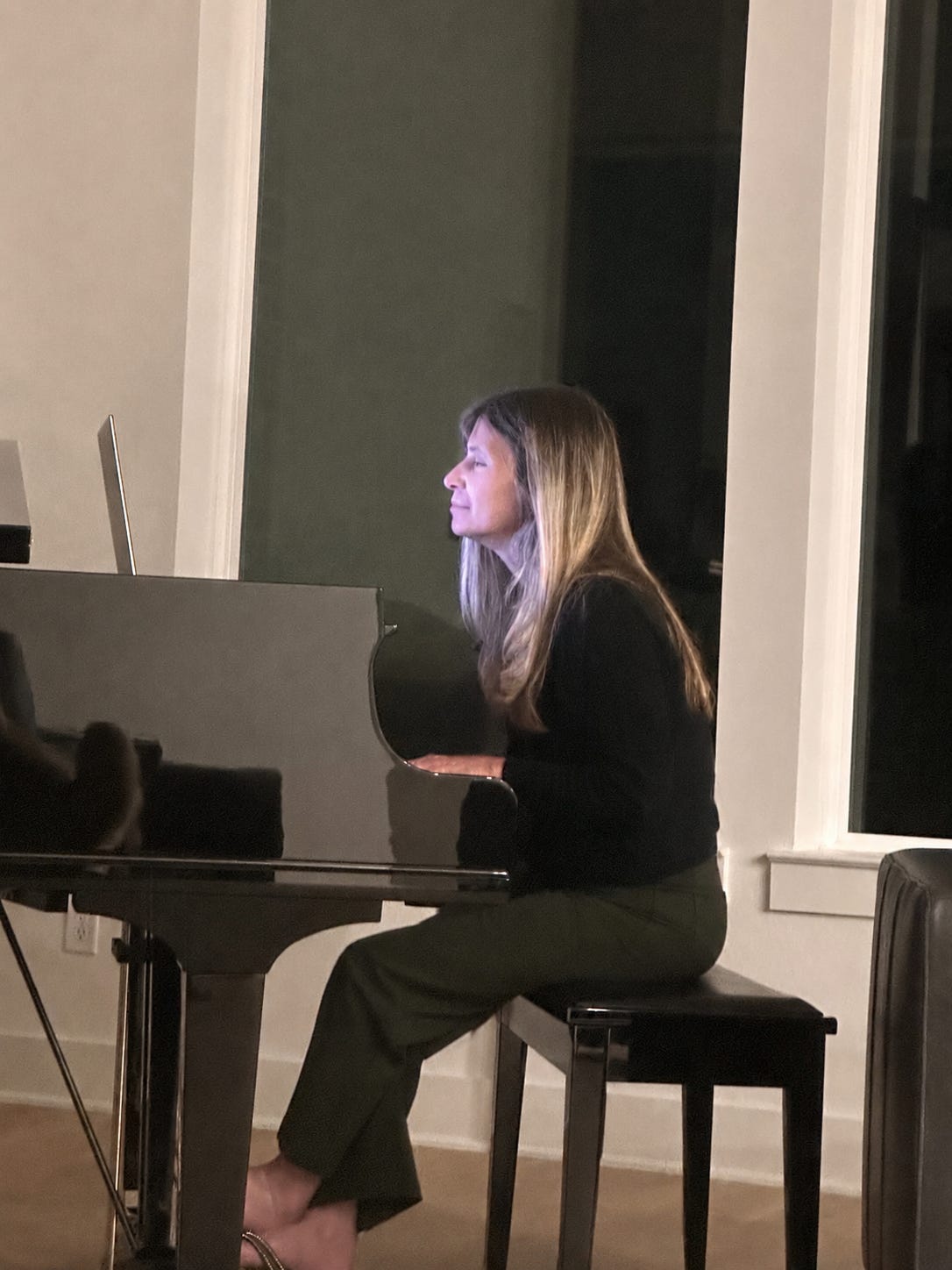
And let me tell you how I know that is not just preacher talk. I know it because of a piano.
My mother had a piano.
The thief took her breath, but he never got her piano — and it turns out he never got her, either.
Because there have been some evenings my wife Renee sits down at those same keys, and the whole house fills up with sound, and a peace I can only call the peace of God settles over a room that has no earthly business being at peace.
And some evenings it is my son Zach at that piano — my mother’s piano — and the song that rises up out of it is “On Eagle’s Wings.”
If you do not know it, it is built straight out of the old promise in Isaiah — that those who wait on the Lord will mount up with wings like eagles, that God Himself will bear you up and hold you.
My mother is gone from this side of heaven.
And her piano is still preaching that promise, under the hands of her grandson, in the house where I live.
The thief took her breath.
He never got the song.
He never gets the song.
That is the echo of a spirit the grave was certain it had silenced — and I have heard it with my own ears, in my own home, on my own mother’s piano.
So do not sit there and tell me the best is behind us.
When I sign these letters “The Best Is Yet to Come,” I am not whistling past the graveyard.
I have been in the graveyard.
I have done the services and folded the flags and lowered the boxes — and I have held my own mother’s hand while the breathing stopped.
I am telling you that the One who wept at a tomb is the same One who walked out of His own. That is the only reason a man who has heard “pray I die” from a hospice bed, and felt his mother’s hand go still, can still — with a straight face and a steady voice — deal hope.
So here is where I land, with a young loved one’s diagnosis sitting on my chest like a stone — and maybe yours sitting on yours.
I do not have the words.
I am never going to have the words.
Thirty more years and I still will not.
But I have a chair.
And I will pull it up next to you, and I will stay, and when I finally run out of things to say I will just be there — which, it turns out, was the whole point the entire time.
And the God who wept is in the room.
He always was. He always is.
Pull up a chair.
The Best Is Yet to Come,
Your Hope Dealer,
Pastor John (Rookie Roberts)
All of us have been in the rooms with loved ones finishing their earthly life. It is so hard--there are no magic words, but just being there is powerful. It helps the person leaving--your presence is soothing to them. It also helps the person sitting beside them. I was in that chair when my father left--he knew I was there even though he was not conscious, There was still a closeness that I often reflect upon even though he has been gone over 20 years. I thank you, John, for writing these devotionals that help us visit these difficult times and learn from them and take hope!