
The 76th Letter
A Memorial Day follow-up — the letter Jimmy never got to write, finally delivered.

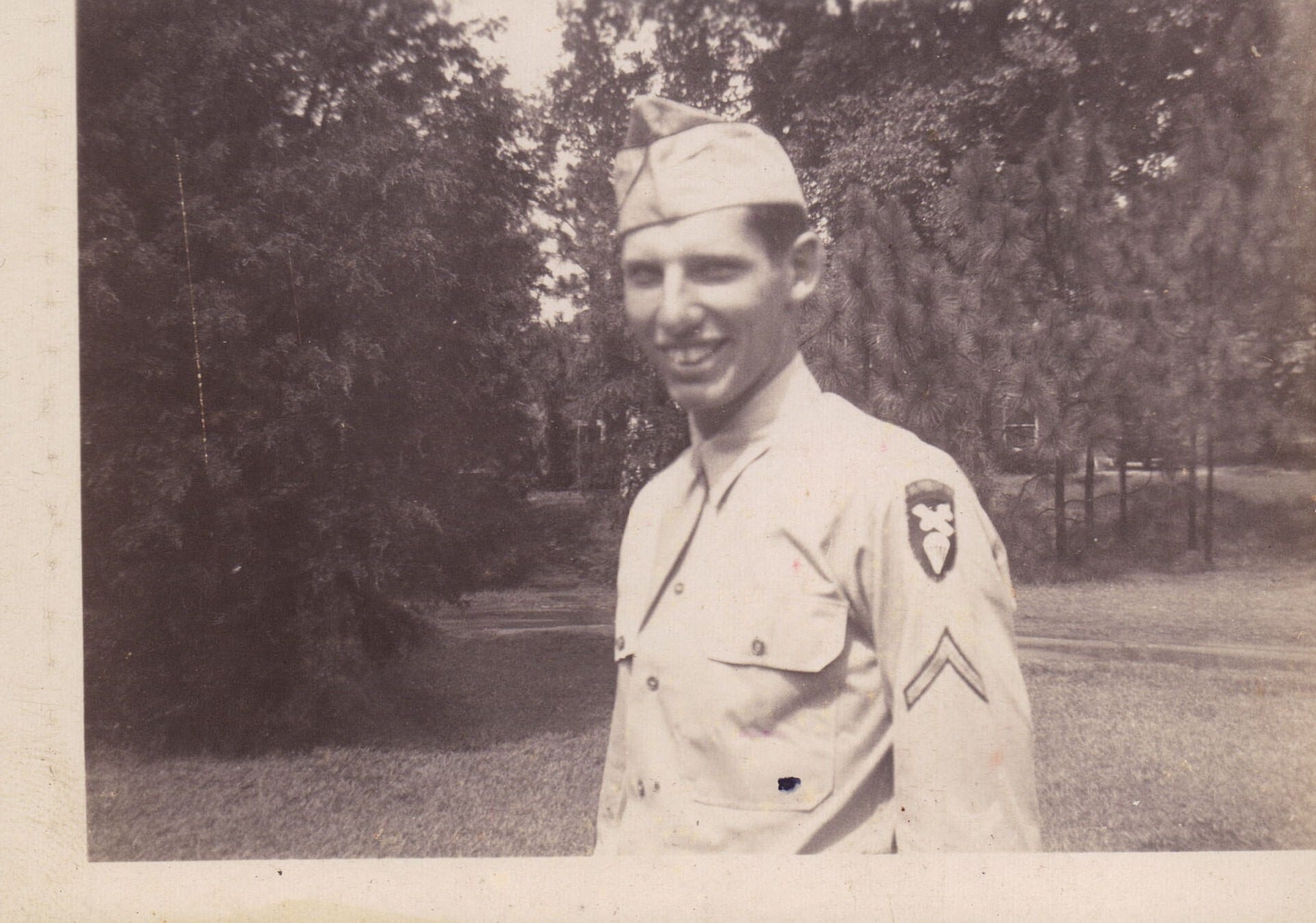
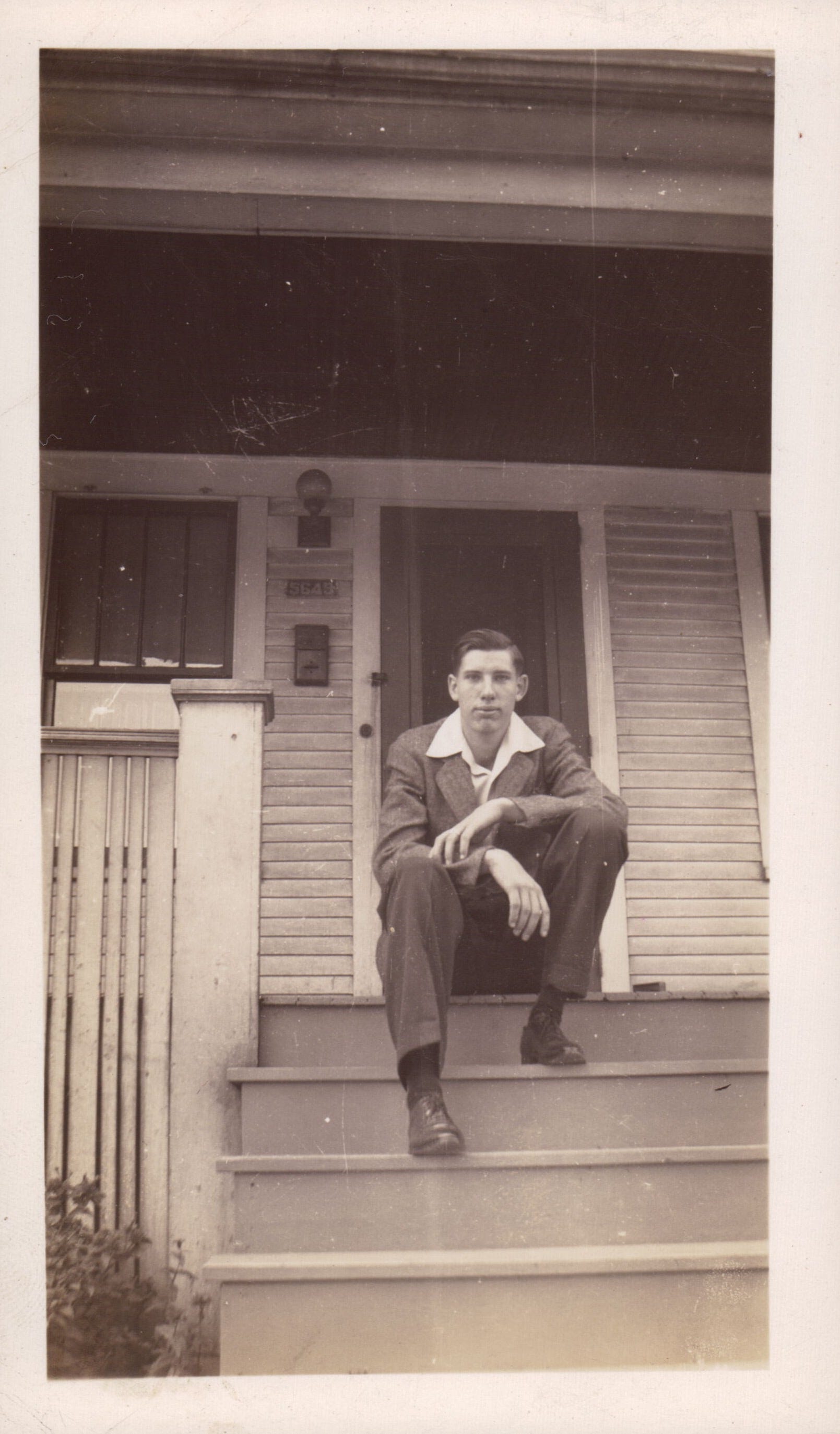
The Seventy-Sixth Letter
What Jimmy Would Have Written If God Had Let Him Write One More
Yesterday I told you about my dad’s cousin.
Sergeant Julius James Wery.
His friends called him Jimmy.
I told you about the seventy-five letters he wrote home to his mother, my Aunt Gert. About the divorce his father asked for while Jimmy was overseas. About his wife Rhea who went and lived with him at Fort Bragg before he shipped out. About Lt. DeLeo’s letter to Aunt Gert twelve days after Jimmy was killed. About the white cross at the American Military Cemetery in Margraten.
I thought I was finished.
I wasn’t.
Because in the twenty-four hours since I sent that devotional, my dad has texted me twice and emailed me once.
He is eighty-eight years old. He lives in an assisted living home now. He has been a retired Air Force Colonel for decades. He has spent the last few years going through Jimmy’s letters one at a time, slowly, the way a man does when he is rebuilding a cousin out of paper — first in his own living room, and now from a chair in a room that is not quite his.
He has saved them on an app called Forever, which is how I got them.
My dad told me about his cousin’s wedding in North Carolina that Aunt Gert and Uncle Pete refused to attend together because their marriage was already falling apart.
He told me how Rhea said no when Aunt Gert wanted to bring Jimmy’s body home from Europe — let him stay with the boys he died with — and how Aunt Gert never quite forgave Rhea for it.
He told me about Aunt Gert’s bitterness. And what that bitterness did to other people in the family. People I never met. People I am related to. People who carried something they did not choose to carry, because a mother in Michigan could not put down the loss of her only son.
He told me about the polio he overcame.
He told me about the train.
A 1927 Lionel that has been running in our family for ninety-nine years.
The License
And then last night, I went looking.
I had been thinking about Jimmy and Rhea all day. About Fort Bragg. About the wedding nobody seemed to know much about. About the question my dad kept circling and could not quite answer — was anybody from the family there?
So I started searching.
And I found it.
The marriage license.
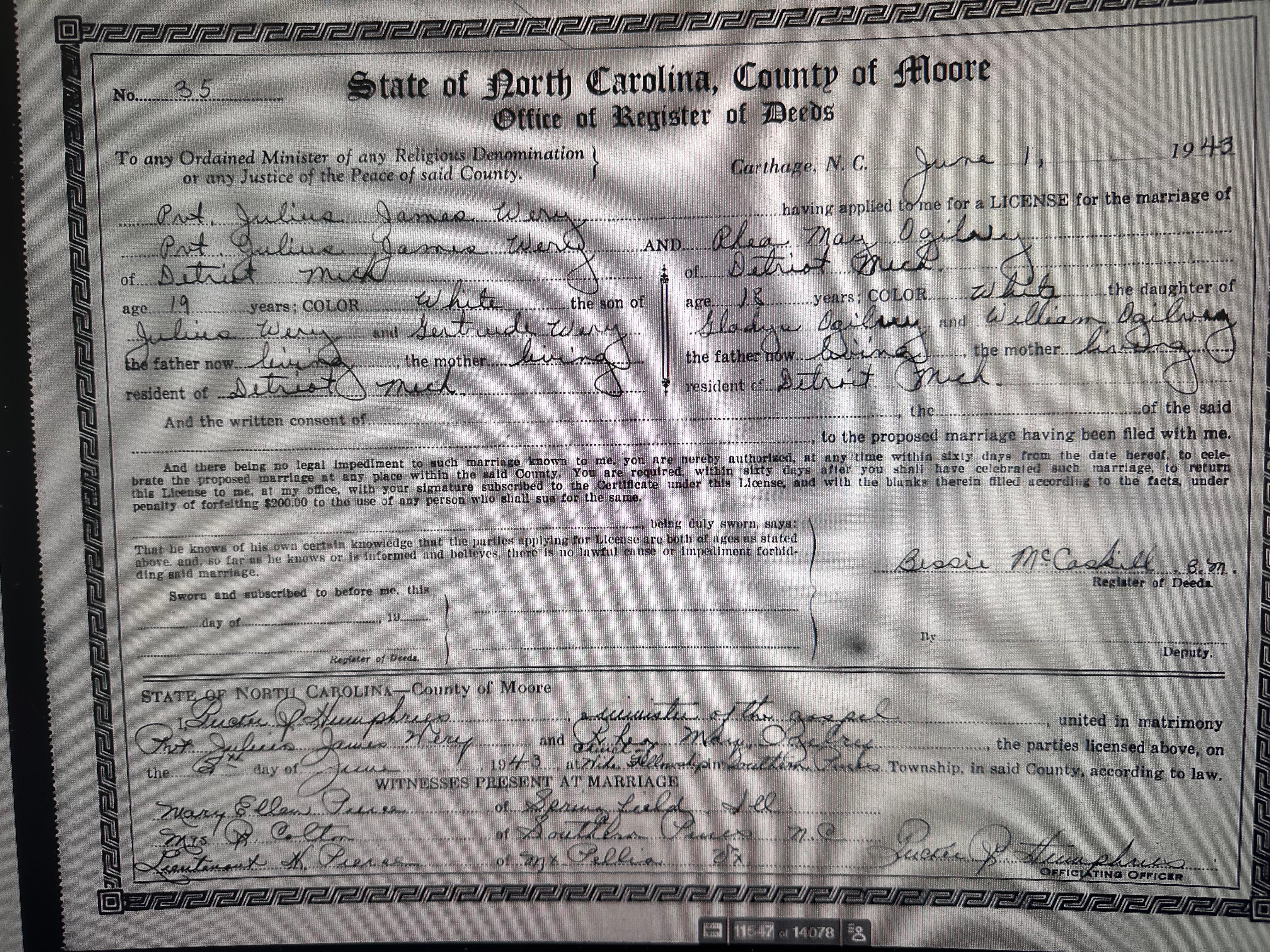
The actual document. State of North Carolina, County of Moore, Office of the Register of Deeds. License Number 35. Issued in Carthage, North Carolina, on June 1, 1943. The marriage solemnized two days later — June 3, 1943 — by Rev. Lester J. Humphries, Minister of the Gospel, in Southern Pines Township.
Pvt. Julius James Wery, age 19, of Detroit, Michigan. Son of Julius Wery and Gertrude Wery. Both parents listed as living.
Rhea May Ogilvy, age 18, of Detroit, Michigan. Daughter of William Ogilvy and Gladys Ogilvy. Both parents listed as living.
Four parents.
All four alive.
All four in Detroit on the day the license was issued.
Now look at the bottom of the document. Look at the line that says Witnesses Present at Marriage.
Mary Ellen Pearson of Springfield, Illinois.
Mrs. R. Colton of Southern Pines, North Carolina.
Lieutenant H. Pierson of Texas.
That’s the wedding party.
A friend from Illinois. The minister’s wife from down the road. A lieutenant Jimmy served with.
No Wery. No Ogilvy. No mother. No father. No brother. No sister. No cousin.
Nobody from home came.
Friends — I have looked at a lot of marriage licenses in twenty years of ministry. I have signed a thousand of them. I have officiated weddings where the divorced parents sat on opposite sides of the sanctuary and managed it like adults for one afternoon. I have officiated weddings where the bride’s father walked her down the aisle while the groom’s mother glared at him from the second row. I have officiated weddings where the in-laws hated each other and showed up anyway because that is what you do when your child gets married.
This license is the physical evidence that Aunt Gert and Uncle Pete could not even do that.
Their only son was getting married in North Carolina before he shipped out to war. He was nineteen years old. He had eighteen months to live and nobody in that room knew it yet — but his parents knew there was a war on. They knew he was going overseas. They knew this might be the only wedding he ever had.
And they did not come.
Not separately. Not together. Not at all.
Rhea’s parents did not come either.
Eighteen years old, marrying a soldier two days after the license was issued, in a fellowship hall in a town she had never seen, witnessed by a woman she had probably met at the base and a lieutenant whose first name nobody wrote down.
And her mother and father stayed in Detroit.
I do not know why. I will never know why. Perhaps because Aunt Gert’s and Pete’s marriage was coming undone? Anyone who could have told us is dead.
But here is what the license tells me, eighty-three years later, after a Tuesday night spent digging through a database with my reading glasses on at the kitchen table:
Jimmy and Rhea got married alone.
The two of them. The minister. Three strangers. And God.
That is who was in the room on June 3, 1943.
And friends — when you read the imagined letter that follows in a minute, when you read Jimmy thanking Rhea for coming to Fort Bragg, when you read him blessing her remarriage, when you read him saying he was the first one on his feet at her second wedding — I want you to remember the license.
Because the two of them started with nobody.
And somehow they made a marriage that lasted Jimmy’s whole short life and shaped Rhea’s whole long one.
Two kids. Three witnesses. One God who showed up when nobody else would.
That is the marriage Jimmy is writing his letter from.
As I have been thinking and praying about all of this, I started thinking about something my dad had not said out loud.
What about the seventy-sixth letter?
The one Jimmy never got to write.
The one that should have come a week later — Mom, we are almost done over here. The war is almost over. I am coming home. Rhea and I are going to start our lives.
That letter never came.
Because the mortar shell did.
The Seventy-Sixth Letter
I am a pastor, not a novelist.
I cannot bring Jimmy back. I cannot put a pen in a dead man’s hand. I cannot reach across eighty-one years and ask him what he would say if he could write one more.
But I can do what preachers have always done.
I can imagine.
The way the prophet Ezekiel imagined the dry bones standing up.
The way Paul imagined what we will say when this mortal puts on immortality.
The way C.S. Lewis imagined a country at the back of the wardrobe and called it more real than this one.
So here it is.
The letter Jimmy would write, if God let him write one more, at least as how I see it.
Not from France. Not from Belgium. Not from Germany.
From home.
From the country he is in now.
To Rhea, My Wife
My Rhea,
Do you remember Fort Bragg?
Our quarters on base when you came to live with me before they shipped me out? The way you set the table for two even when I came in late from training and the food was already cold? The way you said you were not going to spend the war waiting in Michigan when you could spend it with me in North Carolina?
I think about that more than you know.
I want to tell you something I could not say in the seventy-five letters because I did not have the words yet.
Thank you for letting me go.
Thank you for not asking me to find a way out. Thank you for not begging me to come home before the job was done. Thank you for being the kind of woman who could send a man to war and trust God with the rest.
And Rhea — listen to me now —
Thank you for what you did after.
I know you did not want to keep my body in Europe. I know my mother begged you to bring me home. I know there were nights when you wished you could go to a grave you could touch. I am sorry for those nights.
But you were right.
A soldier belongs to the ground he gave his life for. The boys I served with are buried around me. We are still together. We still answer roll call. You gave me to them when you let me stay.
And Rhea — about the six years.
I know about them.
Six years and two months you were Mrs. Julius J. Wery after the telegram came.
You were twenty years old when I died. You did not have to keep my name. You did not have to wait. The whole country was pairing off again — V-E Day, V-J Day, the boys coming home, the weddings in every Catholic parish from Ecorse to St. Clair Shores. You could have folded the flag and moved on inside a year and no one would have blamed you.
You waited until you were twenty-six.
Six years, Rhea.
You gave me six years of your own life that you did not have to give.
My mother never knew that. My mother counted the months and decided you had moved on too fast. She was wrong, Rhea. She was wrong about you in a way that I want to put right tonight, even if it is eighty-one years late.
You were faithful.
And then — May of 1951 — you married him.
Mr. Wambeke.
A good Belgian Catholic name from a good Belgian Catholic neighborhood. The same kind of family I came from. Probably the same kind of parish. Probably a man who knew somebody who knew somebody who knew me.
I want you to know something.
I was not jealous.
Not for a minute.
When you said yes to him — I was standing in the back of that little church, and I was the first one on my feet.
Because here is what a husband wants for his wife when he cannot be her husband anymore.
He wants her to be loved.
He wants somebody to bring her coffee in the morning. He wants somebody to fix the porch light. He wants somebody to sit beside her in church and hold the hymnal so she does not have to hold it alone.
He wants somebody to be there when the news is bad and somebody to be there when the news is good and somebody to be there on the ordinary Tuesdays when there is no news at all.
Mr. Wambeke gave you that.
For close to fifty years he gave you that.
You were Rhea Wambeke longer than you were anything else — longer than you were Rhea Ogilvy, longer than you were Rhea Wery. Half a century beside him in St. Clair Shores.
You did not betray me when you married him. You honored me.
Because the worst thing that could have happened — worse than the mortar shell, worse than the telegram, worse than my mother’s bitterness, worse than the field in the Netherlands — would have been a young woman in Michigan deciding that because Jimmy Wery did not get to live, she would not get to live either.
Two coffins for one mortar shell.
I would not have wanted that.
I do not want that.
And Rhea — about Ann Marie. About Catherine.
Your girls.
I see them.
I have seen them from here.
I saw Ann Marie the day she was born and I saw Catherine the day she was born and I saw both of their wedding days — Ann Marie to John Mellen, Catherine to Frank Matuska — and I saw the five grandchildren you held in your arms and I saw you become the grandmother you never got to be with me because we never got that far.
Rhea, those two girls are the seventy-sixth letter.
They are the letter I never got to write you. They are everything I would have wanted for the woman I married at nineteen.
They are the proof that you did the bravest thing a young widow can do — you let yourself be loved a second time, and you let yourself love back.
I bless every birthday of theirs I never got to attend.
I bless every Christmas at a table I was not at.
I bless the photographs on Mr. Wambeke’s mantel where my face was not in the frame.
I bless the obituary your daughters wrote in 2001 that did not mention me — because they were honoring their father, the way good daughters do, and that is exactly as it should be.
You lived a full life, Rhea.
April 30, 2001. Seventy-six years old. Fifty-six years past the telegram. Two daughters at your bedside. Five grandchildren who knew your voice. A husband already waiting on the other side of the door for you.
I was waiting too.
Not as a rival. Not as a claim. Not as the boy you had to choose between.
As your first friend. As the eighteen-year-old who took you to North Carolina. As the one who got to be your husband for one year and seven months and is now grateful — endlessly, eternally grateful — that you had fifty more years to be somebody else’s wife and somebody’s mother and somebody’s grandmother.
Do not carry me like a chain.
You never did, Rhea. You laid me down the day you married him, and you were right to. I am writing this letter to tell you that you were right to.
I went to war so that you could have a life.
You had one.
Thank you.
All of my love, forever and from here,
Jimmy
To Mom — Aunt Gert
Mom,
I have been wanting to write you for eighty-one years.
I know about the prayer.
The clipping you cut out of the newspaper and pasted onto the matting of my photograph. “A Mother’s Prayer For Her Boy. As Thou didst walk the lanes of Galilee…” I saw you paste it on. I saw your hands shake.
Mom, He did walk with me.
He walked with me at Fort Bragg. He walked with me on the boat to England. He walked with me through France and into Belgium. He walked with me on the patrols when I was a Forward Artillery Observer crawling close enough to the German guns to call our own fire down on top of them.
He was with me on March 2.
He was with me when the mortar came in.
And He has been with me every day since.
Mom, I have to tell you something hard.
I know what happened after.
I know you wanted to bring me home and Rhea said no. I know you never quite forgave her. I know you never quite forgave Dad.
I know you never quite forgave God for letting your only son die five months before the war ended.
I know the bitterness.
I know what it did to you. I know what it did to the people around you.
I know what grief does when it has no place to go — it does not stay in one heart. It travels. It infects. It bends marriages and breaks families and writes itself into the lives of people who were not even born yet.
Mom, put it down.
Put it down.
I am not in a field in the Netherlands.
I am with the Lord you taught me to pray to when I was a boy.
The prayer on the matting was answered.
Just not the way you wanted.
I am home, Mom.
Stop waiting for me at the front window.
And forgive them. Forgive Dad. Forgive Rhea. Forgive yourself.
The war is over for me. Let it be over for you.
Your son,
Jimmy
To Little Cousin Jim
Jim,
You were seven years old.
You had just gotten out of the polio ward. You were learning to walk again. And on March 2, 1945 — your seventh birthday — the telegram came to my mother’s house in Michigan and the news reached yours, and a birthday cake got put away half-eaten.
I am so sorry, little cousin.
I am sorry the war took your birthday.
I remember you in those days — skinny, recovering, eyes too big for your face, watching me in my uniform like I was somebody.
Jim, you were a hero too.
You beat polio.
You grew up. Played football at the Naval Academy. Then you joined the Air Force. You made Colonel. You raised a family. You went all the way to Margraten in 2012 and stood at my grave and Jan took the picture and you put your hand on the top of my cross like a man rests his hand on a friend’s shoulder.
Eighty-one years, Jim.
You kept me alive for eighty-one years.
You read my letters in your old age.
You wrote them all down for your sons and daughters.
You told your children and grandchildren about the train.
Jim — let me tell you about that train, because the story is older than either of us.
In 1927 — eleven years before you were even born — my parents gave that train to me.
Then my parents gave it to your parents and your parents gave it to you.
A gift between the cousins.
A Lionel locomotive with a tender and a few cars, the kind of gift people gave each other when families still believed they would always be in each other’s lives.
I played with it as a boy.
Then you played with it as a boy.
Then your folks gave it to you when you were old enough to keep it safe.
And ever since, Jim — for almost a hundred years now — you have run that train. Every December. Under every tree in every house you have ever owned. With Jan beside you for most of those years.
And a couple of Decembers ago, when you knew it was time, you gave it to your daughter.
To Jane.
So that the train would keep running, even when you could no longer run it yourself.
Jim — that may be the most faithful thing you have ever done.
And you have done a lot of faithful things in eighty-eight years.
The train you handed to Jane is the same train you got from your parents, who got it from mine, who gave it to your folks before either of us was old enough to understand what a gift between families even meant.
Ninety-nine years on the same track. Two boys. Then one. Then a daughter.
Then a grandson someday, maybe. Then his children.
Two boys, ninety-nine Christmases, one circle of track that you made sure would outlive you.
Older than the war. Older than my death. Older than my widow. Older than my mother’s grief. Older than every white cross at Margraten.
Still running.
Like the love between our families.
Like me.
Jim, you have spent your whole life being the keeper of a cousin who died at twenty-two.
You did not have to.
You chose to.
And in choosing to — and then in handing the keeping on — you turned my death into something I never could have managed on my own:
a long life.
Not the eighty-one years I would have had if the mortar had landed somewhere else.
But eighty-one years of being remembered.
Eighty-one years of being kept.
Eighty-one years of someone, somewhere, knowing my name.
And now, because of what you did with the train — another eighty-one to come.
That is its own kind of resurrection.
Thank you for being my little cousin.
Thank you for being my long memory.
Thank you for handing the line on while you still could.
And one more thing, Jim — we share a name. Julius James. James. Jim.
You have been carrying my name your whole life.
Now I want to give you back yours.
Live the rest of it for both of us.
I will see you soon.
Jimmy
To You Who Are Reading This
To the rest of you —
The ones who did not know me.
The ones who picked this up on a Tuesday after Memorial Day weekend because your long-winded pastor wrote about a soldier you never heard of.
Listen.
I have one thing to say to you and it is the only thing that matters.
Do not waste this.
Do not waste the freedom you have.
Do not waste the country we died for.
Do not waste the Sundays you can still go to church without a soldier standing outside the door deciding whether to let you in.
Do not waste the elections.
Do not waste the Bible on the nightstand.
Do not waste the daughter at the dinner table who still wants to tell you about her day.
Sixteen million Americans served in World War II.
Four hundred thousand like me, never came home.
Most of them were boys. Most of them were younger than your son is now. Most of them never got to drink legally.
Most of them never got to be a father.
Most of them never got to grow into the men they could have been.
We gave you that.
Not because we were heroic. Because we were needed.
And the ones who could go went, and the ones who got hit got hit, and the ones who came home spent the rest of their lives wondering why God let it be them and not us.
So please —
Live the life I would have lived if I had gotten home.
Marry someone you love. Have children. Hold them. Teach them. Be at their birthdays — all of them. Take them to church. Read them the Bible. Sit on the porch with your wife. Cut the grass. Eat the meal. Pray the prayer. Forgive the brother. Bury the grudge. Show up.
Do not waste it.
That is the only request a dead soldier has the right to make of a living American.
And it is the only one we make.
Your soldier,
Sgt. Julius James Wery, “Jimmy” 215th Glider Field Artillery Battalion KIA Belgium, March 2, 1945 Buried at the American Military Cemetery, Margraten, Netherlands
What the Train Taught Me
Friends — I have to stop here and tell you something. Because something happened to me on those texts with my dad.
Every Christmas growing up, I saw that train. Every Christmas of my entire life. It was background. It was setting. It was the thing under my dad’s tree the way the menorah is the thing on someone else’s mantel — a fixture, a tradition, a piece of furniture from December.
I had walked past that train for fifty-five Christmases and never really seen what it was.
And on the phone the other night, listening to my dad — from his room at the nursing home — slowly piece together for me what that train has done in our family across a hundred years, something cracked open in me.
I think I finally understood what that train is.
It is not a Christmas decoration.
It is a teacher.
It has been teaching my dad something for eighty years that he has been quietly teaching the rest of us, and I am only now figuring it out at fifty-five years old.
What it taught him is this.
You keep someone alive by doing what they would have done with their life if they had gotten one.
Jimmy never got to be a father. My dad raised four kids.
Jimmy never got to grow old with Rhea. My dad and my mom Jan were married for fifty-six years.
Jimmy never got to see his hometown after the war ended. My dad has seen most of this country and a good piece of the rest.
Jimmy never got to set up his own Christmas tree. My dad has set up that Lionel train every December of his life — and every December he did it, somewhere, Jimmy did it too.
That is what the train taught my dad.
And friends — this is what cracked open on the phone — it taught him in such a quiet, ordinary, unspoken way that I lived through fifty-five Christmases of it without ever knowing I was being taught the same thing.
You keep someone alive by living the life they did not get to live.
Not in some dramatic way.
Not by writing books about them or building monuments to them or filing their name in some hall of memory.
You keep them alive by doing the dishes they would have done. By being patient with the child they would have raised. By forgiving the family member they would have forgiven if they had been around long enough to get over it. By taking the trip they would have taken. By being the husband they would have been. By kneeling beside the tree every December and snapping the track back together one more time.
That is how my dad has kept Jimmy alive for eighty-one years.
Not with a speech. Not with a documentary. Not with a Substack devotional from his pastor son in Corpus Christi.
With ninety-nine Christmases under ninety-nine different trees in ninety-nine slightly different living rooms, one train going around the same circle of track, one little boy in 1927 and another little boy in 1952 and a thousand small ordinary acts of fidelity in between.
That is what the train has been teaching us this entire time.
And friends — here is the part I cannot get out of my head —
A couple of Decembers ago, when my dad could no longer keep doing it himself, he taught my sister, his daughter, Jane, the same lesson the train had taught him.
He gave her Jimmy’s train.
He did not say here is your inheritance.
He did not say here is a family heirloom.
He said, in essence — here is a practice. Take it. Keep doing it. Keep someone alive by living the life he did not get to live.
And Jane is doing it.
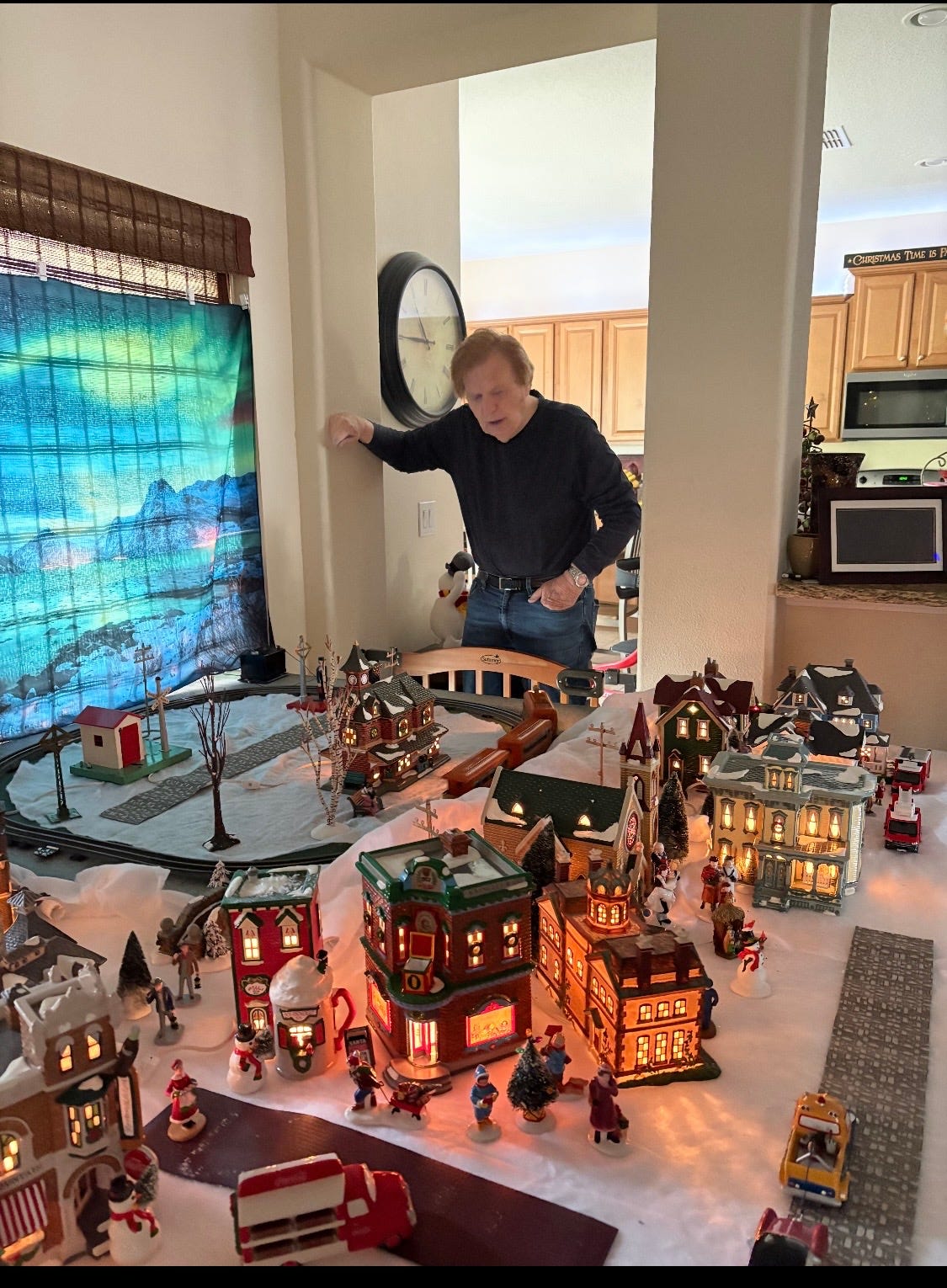
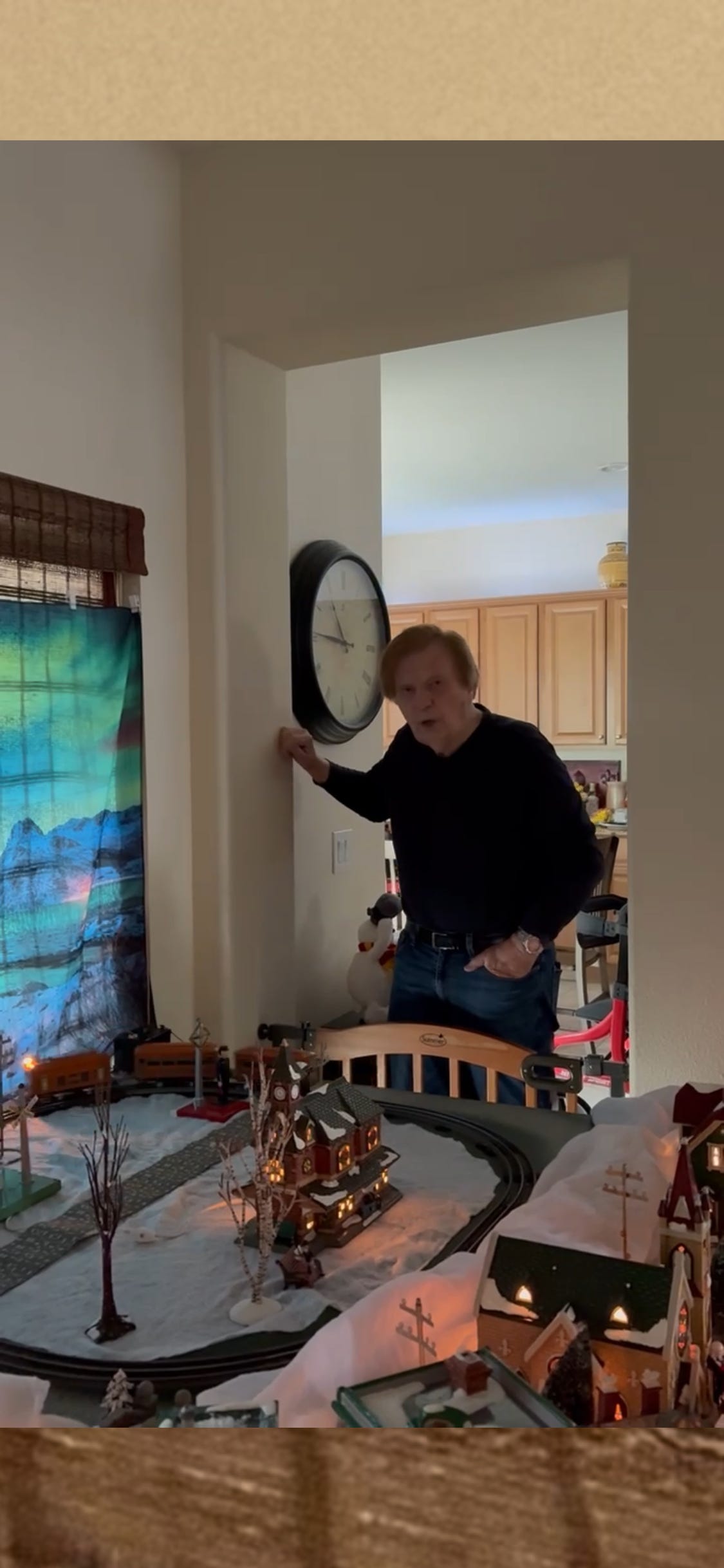
That picture above is from last Christmas. My dad — eighty-eight, just out of his room at the nursing home for the visit, his Jan a hundred miles away under a white stone at Fort Sam — sitting in his daughter’s living room, watching Jimmy’s train go around the track Jane set up.
Three generations of keepers in one room.
Two of them still here.
One of them in the locomotive, going around.
That is what eighty years of faithfulness looks like.
That is what the train has been teaching my family.
And that, friends — at fifty-five years old, in a hotel suite in Corpus Christi, with my own wife in Houston and my own dog in another time zone and my own father in a nursing home and my own mother in Fort Sam Houston — is the lesson I am finally ready to learn.
I have been spending too much of my ministry trying to keep people alive with words.
My dad has been keeping people alive with a train.
He has been doing it better than me.
And the way he has been doing it has been hiding in plain sight under his Christmas tree for fifty-five years of my life.
Friends…
Live the life Jimmy died for.
Forgive the family member you have been at war with for forty years.
Set up the train. Even if the person who used to set it up with you is gone.
Especially if the person who used to set it up with you is gone.
And when the day comes that you cannot set it up yourself anymore — do what my dad did. Hand it to somebody younger. Make sure the line keeps running after you cannot run it.
The locomotive will still go. The track will still close its circle. The Lord will still meet you on the floor beside the tree with a 1927 Lionel in your hands and a memory in your chest you are finally ready to lay down.
The seventy-sixth letter has been delivered.
What you do with it is up to you.
Rev. John
The Best Is Yet to Come Your Hope Dealer Pastor John (Rookie Roberts)
P.S. Dad — I love you. I see you, sitting in that chair at the nursing home, your Jan — my mom — under a white stone at Fort Sam, your cousin Jimmy eighty-one years gone under a white cross in the Netherlands, your train no longer in your living room but still running, every December, in your daughter’s. I want you to know something. The most important thing you ever did, you have already done. You kept the line for sixty years. And when you could not keep it anymore, you handed it to Jane. We will run Jimmy’s train every Christmas, and the boys you both were in 1927 and 1945 will all be in that room with us, and the circle will close one more time, and we will know — all of us — that some things never stop moving. Not as long as someone is willing to plug them back in.
This is so beautiful and touching! I admit that it brought tears to my eyes. I suspect Jimmy was there with you, smiling. Thank you, John, for sharing this precious memory and for sharing Jimmy!